Supreme Court Strikes Down Trump’s Global Tariffs in 6–3 Decision – Major Blow to Trade Agenda
Published Date: 21 Feb, 2026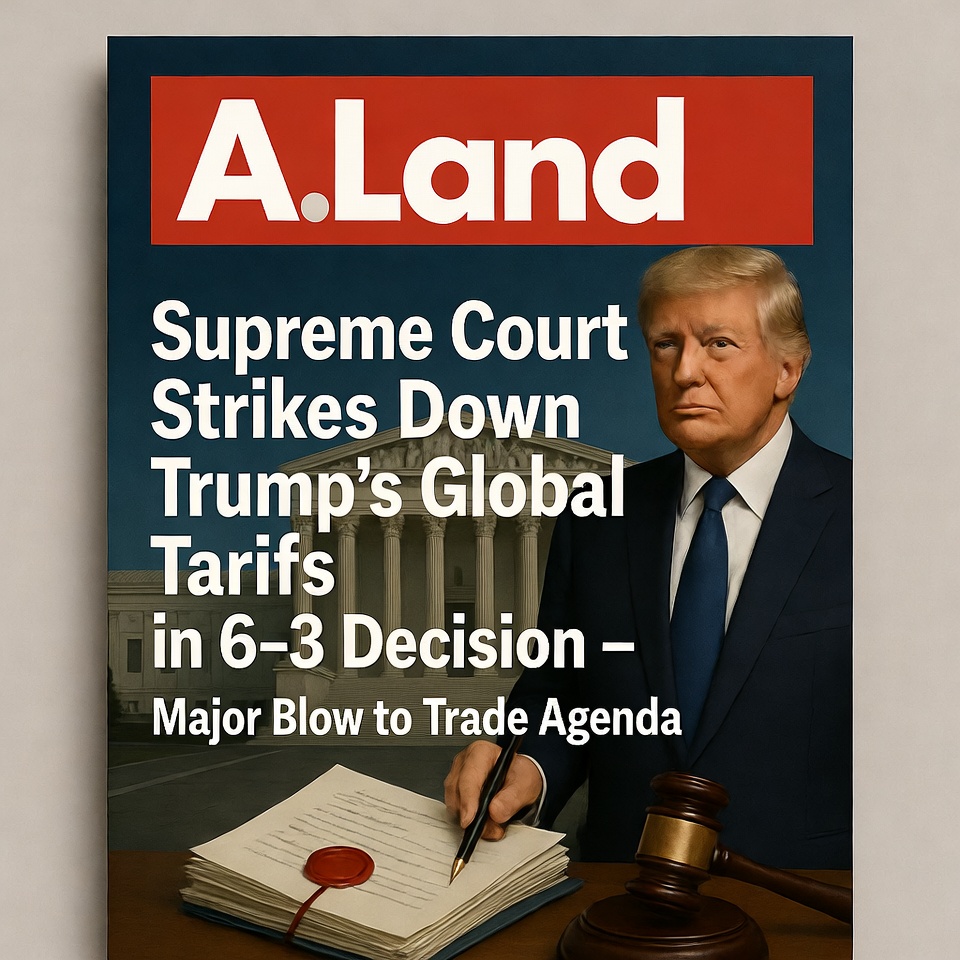
February 21, 2026
In a landmark 6–3 ruling issued today, the U.S. Supreme Court invalidated most of President Donald Trump’s sweeping “global tariffs” imposed under Section 232 of the Trade Expansion Act of 1962 and the International Emergency Economic Powers Act (IEEPA), declaring them unconstitutional and exceeding presidential authority. The decision immediately nullifies duties ranging from 10% to 60% that had been applied to steel, aluminum, automobiles, semiconductors, consumer electronics, pharmaceuticals, and thousands of other imported product categories since early 2025.
Justice Brett Kavanaugh wrote the majority opinion, joined by Chief Justice John Roberts and Justices Clarence Thomas, Samuel Alito, Neil Gorsuch, and Amy Coney Barrett. The Court held that the President may not use broad national security or economic emergency proclamations to impose near-universal tariffs on virtually all trading partners without specific, evidence-based justification tied to a defined threat. The ruling emphasized that such expansive authority would violate the non-delegation doctrine and effectively grant the executive branch unchecked power to tax imports without congressional consent.
Justices Sonia Sotomayor, Elena Kagan, and Ketanji Brown Jackson dissented, arguing that the majority overstepped by second-guessing executive judgments on national security and economic threats.
The decision does not affect targeted sanctions against specific countries (Russia, Iran, North Korea), existing anti-dumping and countervailing duties, or Section 301 tariffs on China. It applies only to the broad, country-neutral “global tariffs” that had affected more than $1.2 trillion in annual imports.
Immediate Market and Economic Fallout
U.S. equity markets surged in pre-market trading: the Dow Jones Industrial Average rose 2.6%, the S&P 500 gained 2.3%, and the Nasdaq Composite climbed 2.9%. Shares of major importers, retailers (Walmart, Target, Amazon), automakers (Ford, GM, Tesla), and semiconductor companies (Nvidia, Intel, AMD) posted strong gains. The U.S. dollar weakened against major currencies as the tariff overhang disappeared.
The National Retail Federation and U.S. Chamber of Commerce hailed the ruling as “a major victory for American consumers and businesses.” The American Iron and Steel Institute and United Steelworkers expressed deep disappointment, warning of renewed import surges and job losses in domestic manufacturing.
White House and Political Response
President Trump denounced the decision as “a terrible ruling by activist judges” and vowed to “use every remaining lawful tool to protect American workers and industries.” Administration officials indicated they are exploring narrower, industry-specific tariffs under existing trade remedy laws (Sections 201, 301, and 232) and may push Congress for new legislation restoring broader presidential tariff authority.
Senate Majority Leader John Thune (R-SD) and House Speaker Mike Johnson (R-LA) issued a joint statement pledging to “act quickly” on legislation to restore executive trade powers, though passage remains uncertain in a narrowly divided Congress. Democratic leaders, including Senate Minority Leader Chuck Schumer and House Minority Leader Hakeem Jeffries, called the ruling “a win for American families who have borne the cost of unnecessary tariffs.”
Legal and Policy Background
The case originated as Retail Industry Leaders Association v. United States, brought by a coalition of retailers, manufacturers, and trade associations challenging the President’s expansive use of national security and emergency powers to impose tariffs without congressional approval. The U.S. Court of International Trade initially upheld most of the tariffs in 2025; the Federal Circuit reversed in part, sending the case to the Supreme Court on an expedited track.
The 6–3 ruling largely follows the logic of the 2019 American Institute for International Steel case but goes further by limiting presidential discretion under both Section 232 and IEEPA when tariffs are applied globally rather than to specific, documented threats.
The Court ordered U.S. Customs and Border Protection to cease collection immediately and begin processing refunds for duties paid since January 2025. The administration has 30 days to comply.
The decision significantly constrains the President’s ability to impose broad import duties without new statutory authority from Congress. It reshapes U.S. trade policy at a time when global supply chains, inflation, and geopolitical competition remain dominant concerns. Further appeals are not possible as the Supreme Court’s ruling is final on federal questions. Implementation, potential new targeted tariffs, and legislative responses will unfold in the coming weeks. Updates will continue as developments emerge.
Date: 21 Feb, 2026