Munich Security Conference 2026 Opens with Stark Warnings on Global Instability
Published Date: 13th Feb, 2026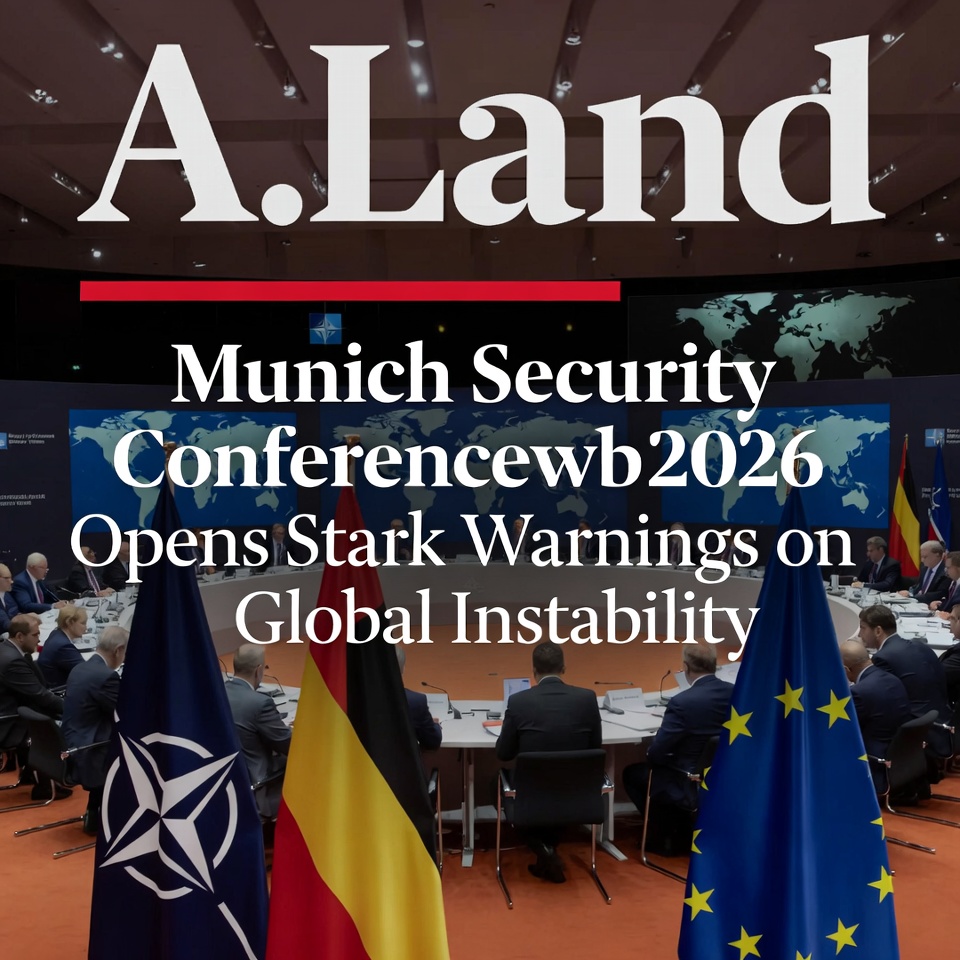
February 13, 2026
The 62nd Munich Security Conference began today in the Bavarian capital with a sobering assessment of international security, as leaders from over 100 countries gathered to confront what many described as the most precarious moment for global order since the Cold War's end. Under the theme “Turning Point – Recalibrating Power,” the four-day event (February 13–16) brings together heads of state, foreign ministers, defense officials, and security experts amid active wars in Ukraine and the Middle East, deepening U.S.-China strategic rivalry, and uncertainty over the direction of U.S. foreign policy under the second Trump administration.
German Chancellor Friedrich Merz opened the proceedings with a blunt warning that “Europe stands at the edge of a new era of hard power politics” and must urgently build credible deterrence while preserving transatlantic unity. MSC Chairman Christoph Heusgen echoed the sentiment, declaring that “2026 may be the most dangerous year for European security in generations” due to simultaneous crises, collapsing arms control frameworks, and the weaponization of energy, migration, and technology.
High-Level Attendance and Key Sessions
The conference features an unprecedented array of participants, including:
- U.S. Vice President JD Vance and Secretary of State Marco Rubio
- Ukrainian President Volodymyr Zelenskyy (via video address)
- Chinese Foreign Minister Wang Yi
- NATO Secretary General Jens Stoltenberg
- EU High Representative Kaja Kallas
- Leaders and top diplomats from France, United Kingdom, Poland, Israel, Saudi Arabia, India, Turkey, and numerous African and Latin American nations
Major agenda items include:
- The future of NATO burden-sharing and U.S. commitment under evolving American policy
- Realistic pathways to sustainable ceasefire and eventual reconstruction in Ukraine
- Prospects for de-escalation in the Middle East following recent U.S.-Iran tariff escalations and Gaza ceasefire implementation challenges
- Managing great-power competition and crisis prevention in the Indo-Pacific
- Countering hybrid threats, including cyber operations, disinformation, and economic coercion
- The intersection of climate change, resource scarcity, and conflict dynamics
Prominent Statements and Early Developments
Vice President Vance delivered a widely anticipated speech outlining the Trump administration’s “America First” approach to alliances. He reiterated U.S. commitment to NATO’s Article 5 while insisting that “European partners must dramatically increase their defense contributions” and accept greater responsibility for continental security. Vance also signaled willingness for pragmatic diplomacy with both Russia and China when it serves U.S. interests.
Chinese Foreign Minister Wang Yi cautioned against “bloc confrontation and a new Cold War mentality,” advocating instead for multilateralism and respect for the “legitimate security concerns” of all nations. Ukrainian President Zelenskyy, addressing the conference virtually, pressed Western capitals to maintain military aid and long-range strike capabilities, warning that “any hesitation in support is a hesitation in survival.”
Israeli and Saudi foreign ministers held separate bilateral meetings on the sidelines, with reports indicating continued discussions on Gaza ceasefire monitoring and potential normalization despite ongoing implementation hurdles.
Parallel Events and Public Protests
Outside the Hotel Bayerischer Hof, several hundred demonstrators rallied for stronger climate-security measures, an end to arms exports to conflict zones, and greater accountability for human rights violations. Side events focused on emerging technologies in warfare, including AI decision-support systems, autonomous weapons, and hypersonic capabilities.
The Munich Security Report 2026, released ahead of the conference, described the current moment as a “multipolar inflection point of maximum danger” characterized by overlapping crises, eroding arms control architecture, and rising risk of major-power escalation.
As the conference continues through Monday and Tuesday with closed-door bilateral talks and the traditional “Munich Consensuses” on key issues, participants will seek signs of progress on Ukraine, Middle East de-escalation, transatlantic burden-sharing, and Indo-Pacific stability. With the world facing multiple flashpoints simultaneously, many observers view the 2026 Munich Security Conference as one of the most consequential gatherings in its history. Live coverage, panel streams, and real-time analysis continue on the official MSC website and partner broadcasters.
Date: 13th Feb, 2026