Interstellar Comet 3I/ATLAS Dives Toward Sun: Third Confirmed Visitor from Deep Space
Published Date: 29th Oct, 2025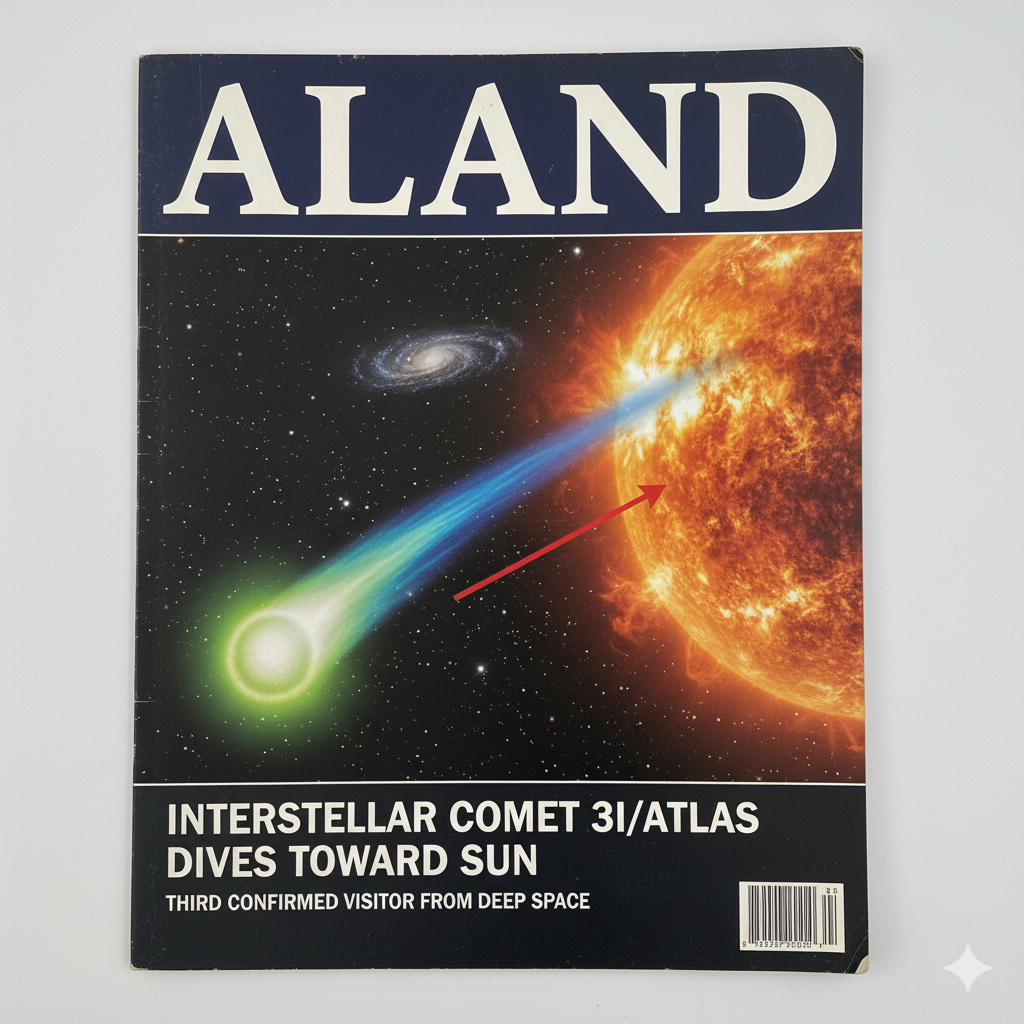
Rare Hyperbolic Flyby Peaks Today, Offers Once-in-a-Lifetime Science
Mauna Kea, Hawaii, October 29, 2025 – At this very moment, an ancient chunk of ice and dust from another star system is plunging past the Sun at 60 km/s, reaching perihelion at 1.4 AU in a fiery solar conjunction that hides it from Earth’s view. Comet 3I/ATLAS, the third confirmed interstellar object, is delivering a fleeting cosmic postcard to humanity—one that astronomers are racing to read before it vanishes forever.
Discovered on July 1 by the ATLAS survey atop Mauna Kea, the comet’s hyperbolic orbit immediately betrayed its alien origin. Unlike the closed loops of our native comets, its trajectory will fling it back into interstellar space by early 2026, never to return. Roughly 20 km across, the nucleus is wrapped in a 26,000-km coma of carbon-rich dust and exotic ices, glowing faintly at magnitude 18 as it streaks through the inner solar system.
Solar Conjunction: A Game of Hide-and-Seek
Perihelion occurs at 14:32 UTC today, with the comet skimming just inside Mars’ orbit while aligned behind the Sun from Earth’s perspective. Ground telescopes are blinded by solar glare, but NASA’s Mars Reconnaissance Orbiter and ESA’s Mars Express are pivoting to capture high-resolution spectra of the comet’s outgassing tail. Early data hint at unusually high levels of heavy isotopes—chemical fingerprints of a birth in a metal-poor star system older than our own.
“3I/ATLAS is a relic from the galaxy’s youth,” said Dr. Karen Meech, principal investigator for the interstellar comet program at the University of Hawaiʻi. “Its composition could tell us how planets formed around the first generation of stars.”
From ‘Oumuamua to Borisov to ATLAS: A Trilogy of Wanderers
- 1I/‘Oumuamua (2017) – Cigar-shaped rock, no tail, mysterious acceleration
- 2I/Borisov (2019) – Classic cometary activity, carbon monoxide jets
- 3I/ATLAS (2025) – Hybrid: active tail + extreme age (7–14 billion years)
Unlike its predecessors, 3I/ATLAS will re-emerge in Earth’s night sky in mid-December, passing 1.8 AU away—close enough for amateur telescopes to spot in Virgo. Peak brightness is expected around magnitude 12, visible with 8-inch scopes under dark skies.
No Danger, Only Discovery
NASA’s Planetary Defense Office confirms zero collision risk. The comet’s path keeps it well outside Earth’s Hill sphere, and its speed ensures a clean exit. Still, the flyby sharpens tracking protocols for future near-Earth objects.
Global Skywatch Campaign
- December 15–20: Best viewing window for northern hemisphere
- Live streams: Mauna Kea, ESO, and NASA TV
- Citizen science: Upload images to iNaturalist’s “Interstellar Comets” project
As 3I/ATLAS rounds the Sun and heads for the Oort Cloud’s edge, it carries secrets no probe could ever fetch. In a universe of 100 billion stars, this fleeting visitor is proof that the galaxy is stitched together by invisible threads of ice and dust—threads that occasionally brush our doorstep, reminding us how small, and how connected, we truly are.
Date: 29th Oct, 2025