Innovation Triumphs: Trio Wins Nobel Economics Prize for Explaining Technology-Driven Growth
Published Date: 13th Oct, 2025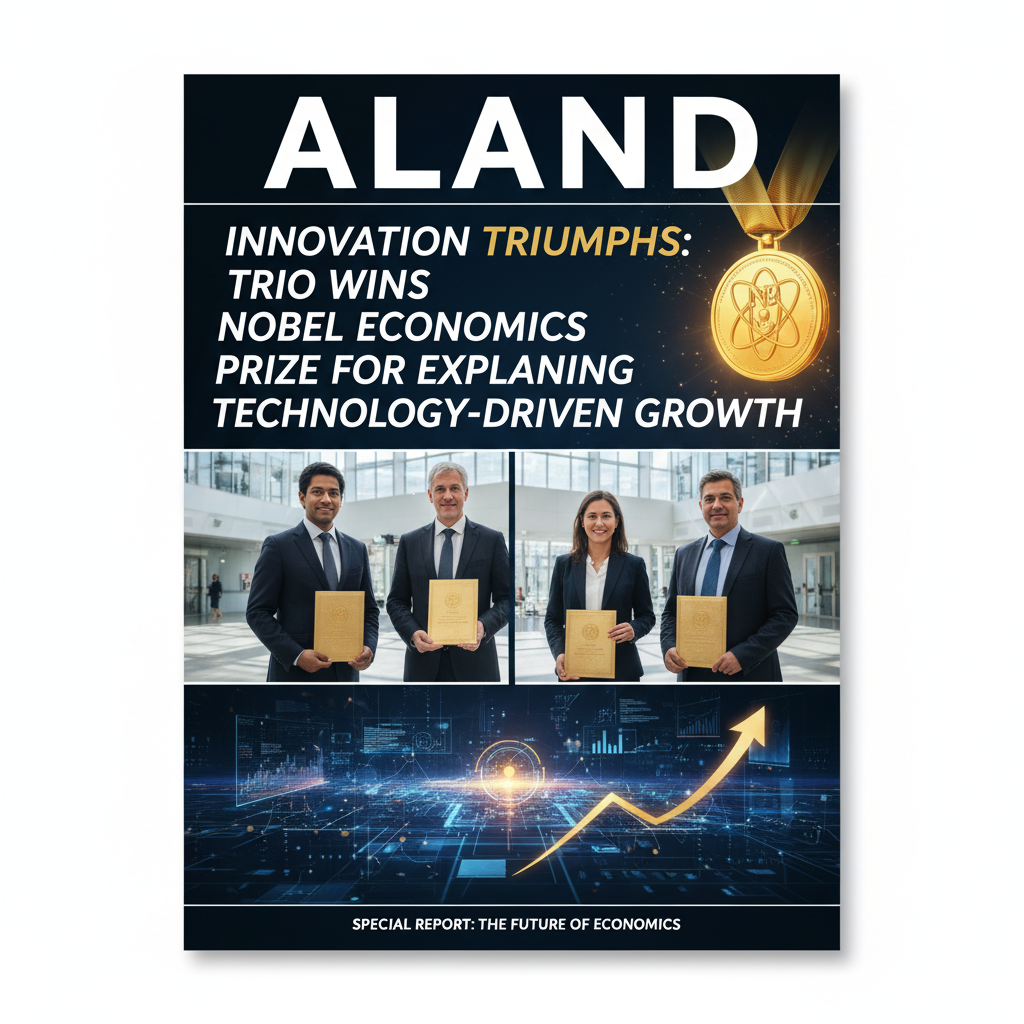
STOCKHOLM, SWEDEN—The 2025 Sveriges Riksbank Prize in Economic Sciences in Memory of Alfred Nobel was awarded Monday to three distinguished academics whose groundbreaking work explains how innovation and technological progress drive long-term economic growth.
The Royal Swedish Academy of Sciences honored Joel Mokyr of Northwestern University, Philippe Aghion of Collège de France and the London School of Economics, and Peter Howitt of Brown University.
The trio's research, which combines economic history with sophisticated mathematical modeling, offers crucial insights into the mechanisms that pull societies out of stagnation and into eras of sustained prosperity.
The Theory of 'Creative Destruction'
One half of the 11 million Swedish kronor prize was jointly awarded to Philippe Aghion and Peter Howitt "for the theory of sustained growth through creative destruction."
Inspired by economist Joseph Schumpeter, Aghion and Howitt constructed a rigorous mathematical model that explains how economic progress works. It shows that growth is fueled by a constant cycle where beneficial new innovations replace, and thus destroy, older technologies and businesses. For example, streaming services destroy the market for physical DVDs, but in doing so, they create new industries and enhance consumer welfare. Their work highlights the vital need to manage the conflicts this disruption creates to ensure innovation is not stifled by established companies.
The Historical Prerequisite for Progress
The other half of the prize went to Joel Mokyr "for having identified the prerequisites for sustained growth through technological progress."
Mokyr, an economic historian, illuminated the historical conditions that allowed Western societies to move from centuries of stagnation to the sustained growth seen since the Industrial Revolution. His research emphasized two key factors:
Useful Knowledge: Progress became self-generating when innovations were based on an understanding of why something works (scientific knowledge), not just that it works (practical knowledge).
Openness to Change: Societies must be open to new ideas and adaptable to change, accepting that new innovations inevitably create both winners and losers.
The committee noted that the laureates' work is particularly relevant today, as global economies grapple with sluggish productivity and the rapid, disruptive rise of technologies like artificial intelligence. Their collective research serves as a clear warning: sustained economic growth cannot be taken for granted; the processes that drive creative destruction must be actively upheld.
Date: 13th Oct, 2025