Hezbollah Disarmament Underway: First Weapons Handover Completed in Southern Lebanon
Published Date: 17th Feb, 2026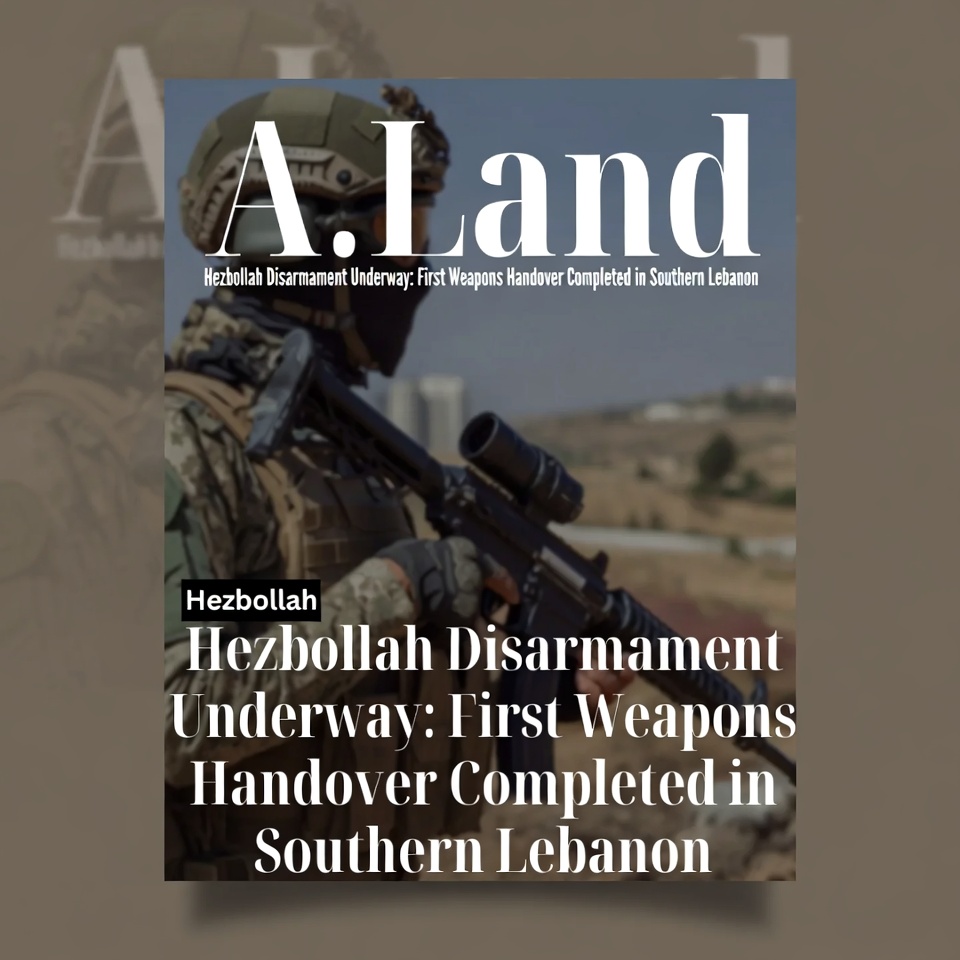
February 17, 2026
Hezbollah has transferred its first consignment of heavy weapons to the Lebanese Armed Forces (LAF) as part of a phased disarmament agreement signed in Beirut last month, Lebanese military sources confirmed Sunday. The handover, monitored by UNIFIL observers and international verification teams, included Grad multiple-launch rocket systems, Kornet anti-tank guided missiles, and several heavy mortars previously positioned south of the Litani River.
The agreement, negotiated with U.S., French, Qatari, and Saudi mediation, requires Hezbollah to relinquish all non-defensive weaponry in southern Lebanon within 90 days, with complete disarmament of the group's independent arsenal targeted for completion by the end of 2027. In return, Hezbollah will receive formal security guarantees, continued representation in a national unity government, and significant reconstruction funding for Shia-dominated areas devastated by recent conflicts.
Hezbollah Secretary-General Naim Qassem announced the initial transfer in a televised statement Saturday evening. He described the move as “a calculated national decision to strengthen the Lebanese state while preserving our right to defend our land and people.” Qassem stressed that the process remains “gradual, transparent, and conditional” on reciprocal Israeli steps, including full withdrawal from disputed border points and cessation of airspace violations.
Lebanese Prime Minister Nawaf Salam called the handover “a concrete step toward restoring full state authority and ending the era of parallel armed structures.” The LAF has deployed additional battalions south of the Litani to receive, catalog, and secure the weapons, with UNIFIL increasing patrols along the Blue Line to verify compliance.
International Response
The United States welcomed the development as “a vital move toward Lebanese sovereignty and regional stability,” with Secretary of State Marco Rubio confirming that phased sanctions relief would continue in line with verifiable disarmament progress. France and the European Union pledged an additional €1.2 billion in reconstruction assistance tied to sustained implementation.
Israel reacted cautiously, stating through a government spokesperson that “only complete and irreversible disarmament, including precision-guided munitions and tunnel networks, will satisfy our security requirements.” Prime Minister Benjamin Netanyahu reiterated that Israel reserves the right to act if Hezbollah retains offensive capabilities.
Iran issued a measured statement via Foreign Minister Abbas Araghchi, saying Tehran “respects Lebanon's sovereign choices” while cautioning against any attempt to “dismantle the resistance framework entirely.” Qatar and Saudi Arabia, instrumental in brokering the deal, described the handover as “a model for de-escalation and state-building in conflict-affected countries.”
UN Secretary-General António Guterres called the transfer “an important initial step” and urged all parties to maintain momentum. UNIFIL commander Lt. Gen. Aroldo Lázaro increased observer deployments in southern villages to monitor the process.
Remaining Challenges
Experts highlight several potential obstacles:
- Hezbollah's insistence on retaining defensive weapons and the right to “resist aggression”
- Verification of hidden arsenals and extensive underground tunnel networks
- Coordination between LAF units and Hezbollah fighters during sensitive handovers
- Israeli demands for parallel demilitarization and cessation of overflights
- Internal Lebanese political resistance from factions concerned about Hezbollah's continued political influence
The initial handover is estimated to represent 15 to 20 percent of Hezbollah's heavy weapons inventory south of the Litani River. Phase two, covering medium-range rocket systems and precision-guided munitions, is scheduled to begin in May 2026.
The disarmament initiative is widely viewed as a critical test of Lebanon's post-conflict governance and the willingness of regional actors to support a viable political settlement. Success could open the door to broader stabilization, economic recovery, and eventual normalization discussions with Israel. Failure risks renewed violence and further erosion of state authority. UNIFIL and international partners will issue weekly compliance updates throughout the process.
Date: 17th Feb, 2026