Global First: South Korea Activates Full-Scale AI Law Today, Setting New Standard for Worldwide Regulation
Published Date: 26th Jan, 2026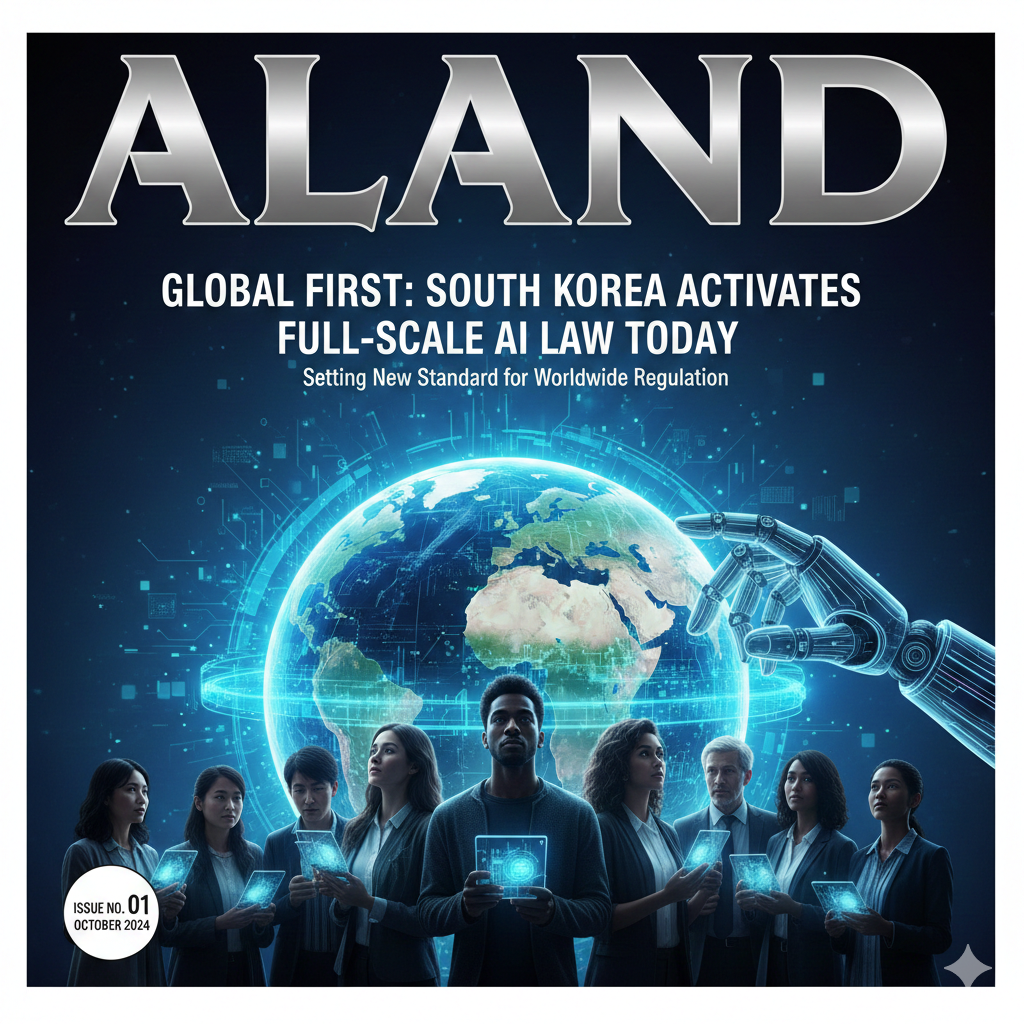
January 26, 2026
South Korea today became the first nation on Earth to fully enforce a comprehensive artificial intelligence regulatory framework, as the amended Basic Act on Artificial Intelligence took complete effect, ushering in mandatory rules for developers, deployers, and users of powerful AI systems.
Unified and Strict: Core Elements Now Binding
The law, which passed parliament last year and phased in gradually, now applies across the board. It requires companies to classify AI systems by risk level, with high-impact models facing the toughest obligations including detailed risk assessments, mandatory human review mechanisms, and clear documentation of decision logic.
Transparency rules mandate that AI-generated content, particularly synthetic images, videos, and audio, carry visible or embedded markers to distinguish it from human-created material and reduce the spread of deepfakes.
Critical Domains Face Highest Scrutiny
Ten high-risk application areas fall under especially stringent controls: nuclear facility management, judicial sentencing support, credit scoring, university admissions, hiring and promotion decisions, facial recognition in public spaces, medical diagnosis tools, biometric authentication, automated welfare allocation, and law enforcement predictive policing.
In these sectors, organizations must perform pre-deployment impact evaluations, maintain detailed audit trails, and allow affected individuals to request explanations and corrections when AI decisions cause harm.
Government Oversight: New Bodies and Enforcement Powers
The Ministry of Science and ICT has stood up dedicated AI safety divisions to review compliance reports, conduct random audits, and investigate complaints. Penalties for serious violations range from corrective orders and public naming to fines scaled to company revenue.
Officials stressed the framework is designed to nurture South Korea's thriving AI industry while preventing societal damage, positioning the country as a trusted leader in responsible innovation.
Industry Mixed Reactions: Innovation vs Burden Debate
Large tech conglomerates welcomed the regulatory certainty that helps attract global partners and talent. Smaller startups and AI service providers voiced stronger concerns, arguing the compliance costs, especially for documentation and third-party audits, could disadvantage domestic players against less-regulated foreign competitors.
Several business associations have requested temporary grace periods or simplified requirements for low-stakes applications to preserve agility in a fast-moving field.
International Benchmark: Eyes on Seoul's Experiment
South Korea's decisive full enforcement contrasts with slower rollouts elsewhere, notably the European Union's AI Act, whose most demanding rules will not fully apply until later years. Regulators and companies worldwide are watching closely to evaluate outcomes, particularly how the law balances rapid technological progress with public protection.
Environmental groups have already flagged an omission: the legislation does not yet address the substantial electricity and water demands of large-scale AI training and inference, an issue gaining urgency as data centers proliferate.
With the full weight of the law now active, South Korean businesses are scrambling to align operations, while policymakers prepare to refine the regime based on early enforcement experience.
This historic step cements South Korea's place at the vanguard of AI governance, potentially influencing how the rest of the world navigates the promises and perils of intelligent machines in the years ahead.
Date: 26th Jan, 2026