Asteroid 2025 FA22 Flies Safely Past Earth — A Close Encounter, Not a Threat
Published Date: 18th Sep, 2025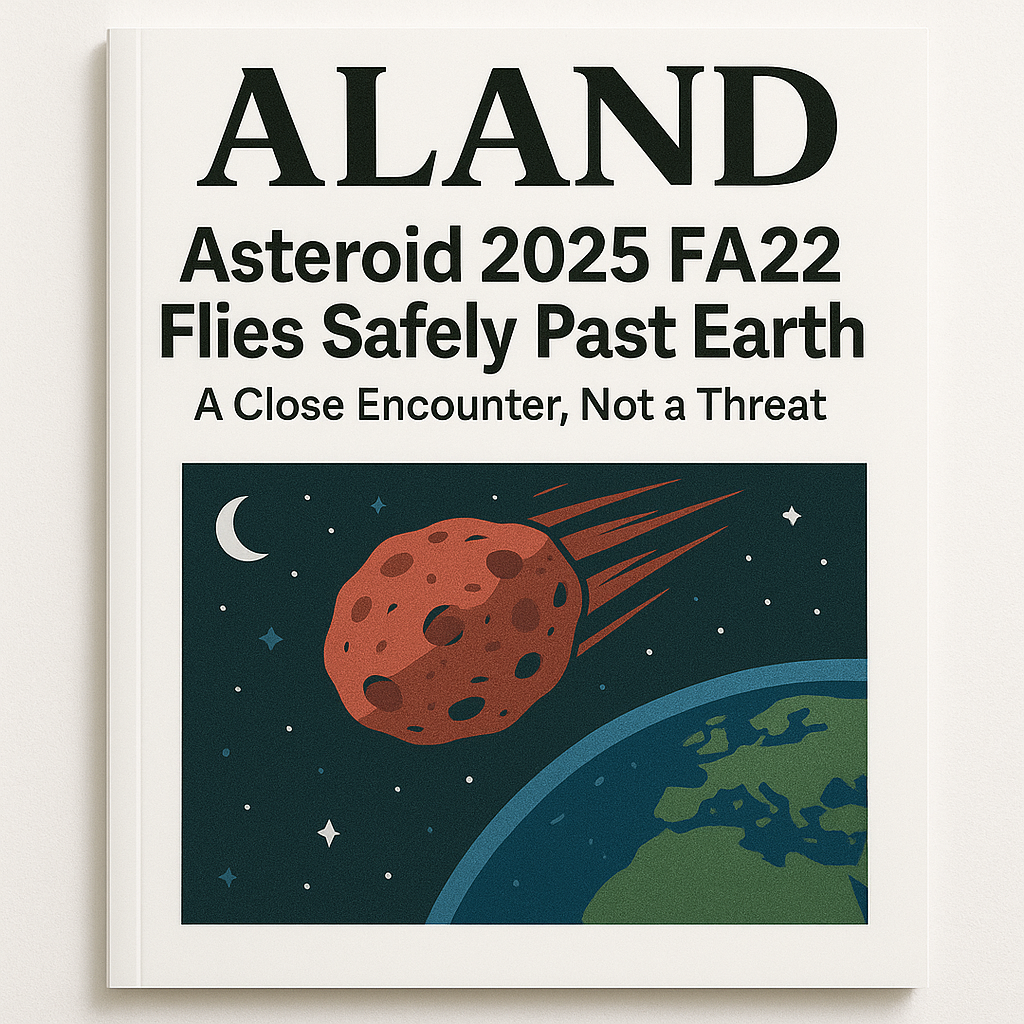
Date: 18 September 2025
On 18 September 2025, the asteroid designated 2025 FA22 made a close flyby of Earth — but scientists have confirmed that it passed at a safe distance and posed no threat.
Key Facts
-
Size: Between about 120 and 280 metres across, making it comparable in height to some skyscrapers.
-
Speed: Roughly 24,000 mph (~38,600 km/h) relative to Earth.
-
Distance at Closest Approach: Approximately 841,000 kilometres, or about 2.2 times the distance from the Earth to the Moon.
What Scientists Discovered & Did
-
2025 FA22 was first discovered in March 2025 by the Pan-STARRS 2 survey in Hawaii.
-
Early data briefly placed it on the European Space Agency’s risk list, with a very low probability of impact in 2089; however, follow-up observations have since refined its trajectory and ruled out any collision risk both now and in the foreseeable future.
-
Because of its size and orbit, 2025 FA22 is classified as a Potentially Hazardous Asteroid (PHA) — largely due to how large it is and how close it came in astronomical terms, though “hazardous” here does not mean imminently dangerous.
Observation Efforts & What We Learned
-
A global observational campaign, coordinated by the International Asteroid Warning Network, tracked the asteroid. Telescopes and radar installations in the United States, Europe, Japan, and Australia worked to refine understanding of its size, shape, surface, and exact orbital path.
-
The flyby provided an opportunity to practise planetary defense systems — modelling how well scientists can detect, measure, and predict close-approaching objects.
-
Amateur astronomers were able to observe 2025 FA22, especially as it reached its brightest magnitude during the nights of 18-19 September. Livestreams and telescope feeds also broadcast the encounter.
Why It Matters
-
While 2025 FA22 posed no risk this time, close flybys like this serve as a rehearsal for how we monitor objects that could become dangerous in the future.
-
Each instance helps refine prediction models, improve telescope and radar techniques, and better prepare international teams for possible future threats.
-
Tracking the orbit and physical properties of 2025 FA22 also helps in estimating what might happen in future encounters, including a predicted flyby in 2173, which will bring it somewhat closer.
The passage of 2025 FA22 is a reminder that Earth’s neighborhood in space is dynamic — large asteroids frequently move through it, sometimes quite close to our planet. Thanks to modern survey systems and global cooperation, this flyby was well understood long in advance and passed harmlessly. At the same time, it provided valuable data and experience for planetary defense.
Date: 18th Sep, 2025