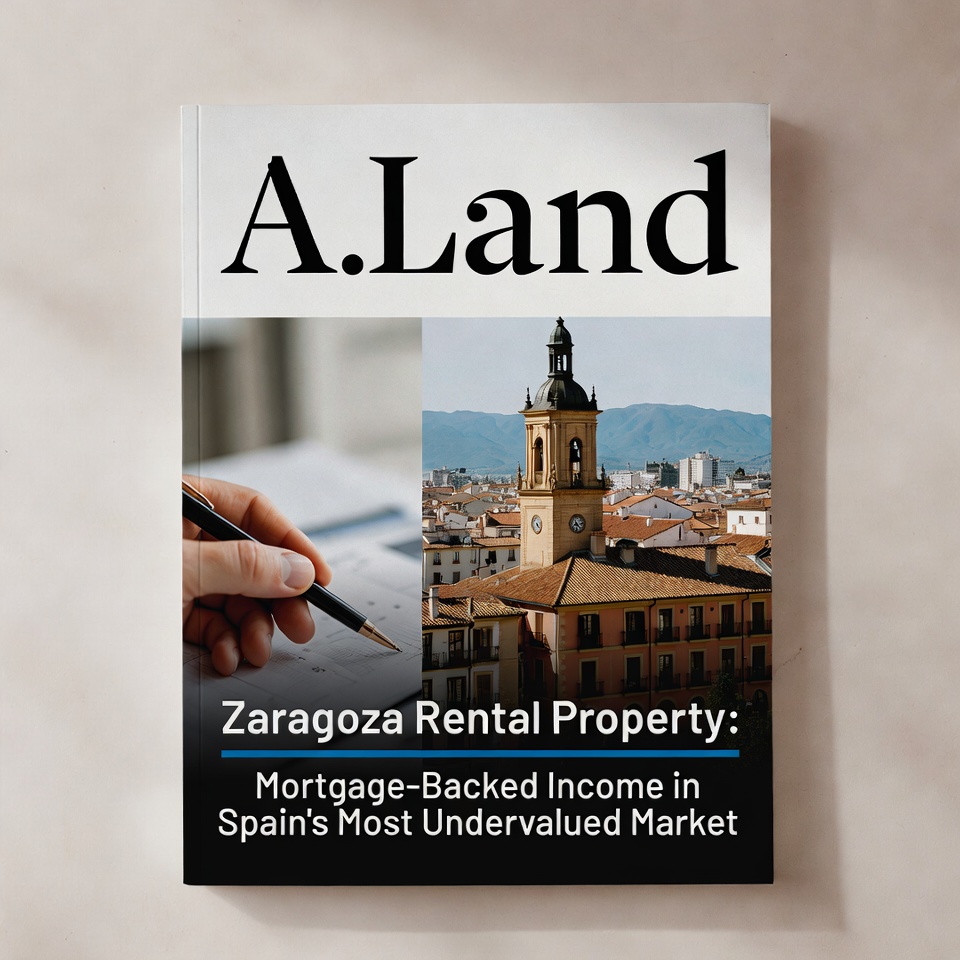
Zaragoza Rental Property: Mortgage-Backed Income in Spain's Most Undervalued Market
- Published Date: 2 Feb, 2026
-
4.8★ ★ ★ ★ ★(236)
Dr. Pooyan Ghamari, PhD Swiss Economist and Strategic Advisor
Zaragoza combines the cash flow advantages of a secondary Spanish market with the infrastructure and employment base of a proper city—something Seville cannot claim. This guide shows you how to buy rental property in Spain's fifth-largest city, exploit entry prices 30% to 40% below Madrid while targeting stable professional tenants, navigate Aragonese mortgage requirements, and build a portfolio that generates genuine retirement income with minimal regulatory interference.
Who This Guide Is For
• You want the cash flow benefits of a secondary market combined with the stability of a diversified economic base (logistics, automotive, services, university).
• You understand that Zaragoza lacks Barcelona's glamour or Madrid's prestige but compensates with superior yields, lower vacancy, and predictable tenant demand.
• You are prepared to invest in a city most international investors overlook, hold for 10 to 15 years, and prioritize income over short-term appreciation.
The 3 Numbers That Decide Whether This Deal Is Real
Before viewing any property, establish these three verifiable numbers. Everything else is marketing noise.
1. Purchase Price
The actual closing price for comparable properties in the same barrio within the past six months. Not the seller's aspirational listing. Not an agent's inflated estimate. Check recent sales through the Registro de la Propiedad or consult a local notary with transaction access. Zaragoza prices vary by district: €1,000 to €1,500 per square meter in peripheral working-class areas like Delicias or Oliver, €1,500 to €2,200 in established middle-class zones like Romareda or Universidad, and €2,200 to €3,000+ in prime central areas like Centro or Casco Histórico.
2. All-In Monthly Costs
Mortgage payment, IBI (property tax), community fees, insurance, maintenance reserve, property management if applicable, and vacancy buffer. Zaragoza has some of the lowest community fees in major Spanish cities due to newer building stock and efficient management, typically €30 to €80 per month for standard residential buildings. Vacancy risk is lower than Seville or Valencia due to year-round employment stability: budget 4% to 6% of annual rent for tenant turnover periods.
3. Realistic Rent
Not the highest Idealista listing. Not optimistic projections. The sustainable rent that actual Zaragoza tenants pay throughout the year. Cross-check Idealista, Fotocasa, and speak with 2 to 3 local property managers who know the districts. Zaragoza rental yields typically range from 5.5% to 7.5% gross depending on location and property type—among the best in Spain for cities with stable employment. These are real, sustainable yields, not inflated by tourism or speculation.
Step-by-Step Blueprint
1. Define Target Tenant and Micro-Location
Zaragoza's rental market is dominated by local professionals and families, not students or tourists. This creates stability.
Young professionals: Districts near business zones and with good transport. Romareda (near offices and shopping), Universidad, Centro. These tenants stay 3 to 5 years, value convenience and modern amenities, and pay consistently. Target one- or two-bedroom units near main transport arteries.
Families: Established residential neighborhoods with schools and services. San José, Casablanca, Actur, Valdespartera (newer development). Families stay 5 to 12 years, generating the most stable rental income. They prioritize space, schools, and parking over luxury finishes.
University students: Near Universidad de Zaragoza campus (Universidad district, parts of San José). Student demand exists but is secondary to professional demand. Shared flats rent reliably September to June but expect annual turnover.
Corporate relocations: Growing segment due to Zaragoza's logistics hub status (Amazon, Inditex distribution, automotive suppliers). These tenants need furnished units near industrial zones or with easy highway access. Higher rent but shorter stays (1 to 3 years).
Zaragoza's advantage: no extreme seasonal vacancy like Seville. The city functions year-round with stable employment from logistics, automotive, services, and public sector. This translates to lower vacancy risk and more predictable cash flow.
2. Choose Property Type That Rents Fastest
Rental velocity reduces risk and maximizes returns.
Two-bedroom, one-bathroom apartment (65–80 m²): The optimal format. Appeals to couples, small families, professional sharers, and corporate tenants. Fastest to rent and re-rent. Build your portfolio foundation here.
Three-bedroom (85–105 m²): Targets families primarily. Higher total rent but narrower tenant pool. Longer vacancy when tenants leave, but significantly longer average tenancies (7+ years) once placed.
One-bedroom (50–60 m²): Good for young professionals and couples. Abundant supply in Zaragoza. Works best in well-connected central or near-university locations.
Avoid studios unless you have a specific university strategy. Studios have highest turnover and lowest quality tenant pool. Also avoid: ground-floor units facing busy streets (noise), top-floor units without elevator in buildings over three floors, and properties requiring major renovation unless you are a contractor.
3. Build an All-In Cost Sheet
Zaragoza has among the lowest operating costs of any major Spanish city, but you still need the complete picture:
Acquisition costs (one-time):
• Property transfer tax (ITP): I cannot confirm the exact Aragón rate, but typically ranges from 8% to 10% of purchase price depending on property value. Verify current rates with the Gobierno de Aragón tax department.
• Notary fees: Approximately €600 to €1,000 depending on property value.
• Land registry inscription: Approximately €300 to €600.
• Legal fees if using a lawyer: €700 to €1,800 (recommended for foreign buyers).
• Mortgage arrangement fee: 0.5% to 1% of loan amount, often waived in competitive offers.
Recurring annual costs:
• IBI (property tax): I cannot confirm exact rates, but typically 0.4% to 1.0% of cadastral value annually. Check Zaragoza city website (zaragoza.es) for district-specific rates.
• Community fees (cuota de comunidad): Among Spain's lowest. €30 to €60 per month for standard residential buildings with elevator. €60 to €100 for buildings with additional amenities. Newer developments in Valdespartera or Parque Goya tend toward the lower end.
• Building insurance: €120 to €300 per year depending on coverage and property value.
• Maintenance reserve: 0.75% to 1% of property value per year. Zaragoza's continental climate (hot summers, cold winters) requires attention to heating/cooling systems and insulation.
• Property management: 8% to 12% of monthly rent if hiring professional management. Essential if you do not live in Zaragoza or lack Spanish fluency.
• Vacancy reserve: Budget 4% to 6% of annual gross rent. Zaragoza has lower vacancy than most Spanish cities due to stable employment base.
Total these costs before evaluating any property. Zaragoza's low entry prices are meaningless if you miscalculate operating expenses.
4. Mortgage Strategy That Banks Accept
Spanish banks typically lend 70% to 80% LTV for residents purchasing investment property, though 70% to 75% is more common for properties outside Madrid/Barcelona. Non-residents face 60% to 70% LTV maximum.
Fixed vs. variable rates:
I cannot confirm current mortgage rates as they fluctuate with ECB policy. As a framework: fixed rates provide payment certainty but typically cost 0.3% to 0.9% more than variable rates at origination. Variable rates (Euribor + bank spread) offer lower initial payments but expose you to interest rate risk.
Compare offers from Ibercaja (headquartered in Zaragoza, strong local presence), CaixaBank, Banco Sabadell, BBVA, Banco Santander. Request the TAEG (APR including all fees) for accurate comparison.
Loan term:
20 to 25 years is standard for investment properties. Longer terms (30 years) reduce monthly payments but dramatically increase total interest cost. Shorter terms (15 years) build equity faster but often create negative cash flow. For cash flow optimization in Zaragoza's moderate yield environment, 25 years typically works best.
Stress test:
Banks stress-test at 2% to 3% above contracted rates. Run your own conservative test: if your mortgage rate increased 2.5% tomorrow, could you cover the higher payment from rent and personal reserves for 12+ months? If not, increase your down payment, lock a fixed rate, or reduce purchase price.
5. Pre-Approval Checklist
Do not waste time viewing properties without mortgage pre-approval. Banks require:
• NIE (número de identidad de extranjero) if non-Spanish EU citizen, or DNI/passport for Spanish citizens.
• Employment contract or proof of self-employment (last two years of tax returns if autónomo).
• Recent payslips (typically last three months).
• Bank statements showing income, obligations, and savings (last six months).
• Proof of down payment funds in Spanish bank account or documented transfer plan.
• Declaration of all existing debts and financial commitments.
• Credit report (CIRBE via Banco de España). Some banks pull automatically.
Pre-approval validity: 60 to 90 days. Use this window strategically to negotiate.
6. Deal Screening Formula
Use these calculations to screen every property:
Gross yield = (Annual rent / Purchase price) × 100
This is what agents advertise. It excludes all costs and provides incomplete information.
Net yield = ((Annual rent - all annual costs except mortgage) / Purchase price) × 100
This shows your return on invested capital before leverage.
Cash flow = Monthly rent - (Mortgage + IBI + community fees + insurance + maintenance reserve + management fee + vacancy reserve)
If negative, you subsidize monthly. Acceptable only if: (1) sustainable from other income for 5+ years, (2) clear path to positive via rent growth or mortgage paydown, (3) realistic about appreciation expectations.
Zaragoza's advantage: achieving neutral to positive cash flow with 70% to 75% LTV is realistic in most districts. Target properties within €150/month of breakeven or better.
7. Due Diligence Checklist
Before signing any contract or paying deposits:
• Request nota simple from Registro de la Propiedad. Confirms ownership, reveals liens, shows restrictions. Cost: ~€10. Available online via Colegio de Registradores.
• Verify no outstanding community debts. Unpaid fees transfer to buyer in Spain. Request certificado de estar al corriente de pago from community administrator. Mandatory.
• Inspect building quality. Zaragoza has both modern construction and aging 1960s-1980s buildings with potential issues. Hire arquitecto técnico for pre-purchase survey if building over 30 years old. Cost: €350 to €700.
• Review community meeting minutes (actas) for past 2 to 3 years. Reveals upcoming assessments, disputes, planned works.
• Obtain energy performance certificate (certificado de eficiencia energética). Mandatory. If seller lacks it, budget €100 to €200 to commission.
• Check cédula de habitabilidad. Occupancy license certifying minimum standards. Required for legal rental.
• Verify IBI payments current. Request last receipt and confirm no debts with municipal tax office.
8. Negotiation Strategy
Zaragoza sellers often list 5% to 10% above realistic prices. Negotiation is standard:
Use comparables: Present recent sales (last six months) of similar properties in same district. Show price per square meter from actual transactions. Anchors discussion in reality.
Quantify defects: Needed repairs, outdated systems, location issues. Calculate remedy costs and deduct from offer. Missing central heating in Zaragoza (cold winters) is worth 3% to 5% discount. No elevator in fourth floor is worth 10% to 12%.
Emphasize financing certainty: Pre-approval and 6 to 8 week closing timeline justifies 3% to 4% off asking for motivated sellers.
Make one serious offer: Zaragoza moves slower than major capitals. Make one justified offer, explain reasoning clearly, set 48 to 72 hour deadline. If rejected, move on. Inventory is sufficient.
Never appear desperate. Zaragoza has ample properties. Patient buyers with clear criteria win better deals.
9. Closing Process Explained Simply
Once offer accepted:
Reservation contract (contrato de arras): Pay 5% to 10% deposit to reserve property and remove from market. Legally binding. You forfeit deposit if you withdraw without cause. Seller returns double if they withdraw. Timeline: 7 to 14 days after agreement.
Bank valuation and approval: Submit property documentation. Bank conducts independent appraisal. If bank values below purchase price, they lend only against their valuation—you must increase down payment. Approval: 2 to 4 weeks.
Notary signing (escritura pública): Scheduled 6 to 10 weeks after reservation. Notary reads deed, confirms understanding, witnesses signatures. You pay remaining down payment, transfer tax, fees. Bank disburses mortgage. You receive keys.
Registry inscription: Notary submits deed to Registro de la Propiedad. Takes 2 to 6 weeks. You own from deed signing, but registry provides full legal protection.
Total timeline: 8 to 12 weeks from offer to ownership.
10. Tenant Selection System
One bad tenant destroys two years of returns. Prevent systematically:
Minimum criteria (non-negotiable):
• Gross monthly income at least 3× monthly rent. Verify with payslips and contract or tax returns if self-employed.
• Stable employment: minimum 6 months current position if employed, 2+ years if autónomo.
• Previous landlord reference. Call directly. Ask: Payment punctuality? Condition? Would you rent again?
Contract essentials:
• 12-month minimum term standard.
• Deposit: one to two months' rent (two more common). Must be deposited regionally within 30 days.
• Clear utility and service responsibilities.
• Annual CPI-linked rent increase clause.
• Detailed move-in inventory with photos, signed by both parties.
Red flags:
• Cash payment requests or contract avoidance.
• Pressure to skip verification.
• Evasive about employment or housing history.
Use professional property manager if you lack Spanish fluency or don't live in Zaragoza. Fee (8% to 12%) negligible vs. one bad tenant cost.
11. Rental Operations
Systematic operations separate success from struggle:
Repairs and maintenance:
Respond within 24 to 48 hours. Small issues cost €60 to €100 immediately. Ignored: €600+ plus tenant dissatisfaction.
Budget 0.75% to 1% property value annually. Common Zaragoza items: heating system maintenance (cold winters essential), cooling system service, plumbing in older buildings.
Annual inspection:
Visit yearly with proper notice (24 to 48 hours required). Check for unreported damage, verify appliance function, assess condition. Document with photos.
Tax compliance:
Rental income taxable in Spain. Residents declare on IRPF, deduct expenses: IBI, community fees, insurance, repairs, mortgage interest, depreciation (3% building value annually, excluding land). I cannot confirm exact rates, but typically 19% to 47% progressive for residents, 19% to 24% flat for non-residents. Consult gestoría.
Reserve fund:
Maintain 8 to 10 months all-in costs in account. Protects against vacancy, repairs, income loss. Don't touch for non-emergencies.
12. Portfolio Expansion Plan
Building portfolios requires patience:
When to buy second:
Wait until: first property rented 18 to 24 months continuously, reserve fund covers 10+ months costs for both, first property neutral/positive cash flow, operations smooth.
Don't buy second to fix first. That amplifies risk.
Refinancing logic:
After 5 to 7 years, if appreciated and principal paid, may refinance for equity. Use only for additional rental down payments, never consumption.
Refinancing costs 1.5% to 2.5% new loan amount. Only refinance if equity extraction significantly exceeds costs.
Risk limits:
Never exceed 4× annual income in mortgage debt. Never let Zaragoza property exceed 60% net worth. Diversification protects against localized shocks.
Geographic diversification:
After two Zaragoza properties, consider third elsewhere (Madrid, Valencia, Bilbao) or different Zaragoza district with uncorrelated demand. Reduces concentration risk.
Portfolio building: 15 to 20 years. Zaragoza's superior cash flow makes this sustainable.
Realistic Example
Two scenarios, 70 m² two-bedroom. Numbers approximate, vary by location/timing. Verify independently.
Scenario 1: Cautious (Working-Class District, e.g., Delicias, Oliver)
Purchase: €105,000 (€1,500/m²)
Down payment (25%): €26,250
Mortgage (75% LTV, 25 years, 3.5% fixed): €78,750 → €394/month
Monthly rent: €550
Monthly costs:
• Mortgage: €394
• IBI (0.6% annually): €44
• Community: €45
• Insurance: €18
• Maintenance (0.9%): €79
• Management (10%): €55
• Vacancy (5%): €27
Total: €662
Cash flow: €550 - €662 = -€112/month (negative)
Gross yield: (€6,600/€105,000) × 100 = 6.3%
Net yield: ((€6,600-€3,216)/€105,000) × 100 = 3.2%
Stress test: Rate to 5.5%: payment €510. Cash flow: €550-€778 = -€228.
Interpretation: Modest negative €112/month (€1,344 annually) sustainable with stable income. Better than comparable Madrid/Barcelona.
Scenario 2: Normal (Middle-Class, e.g., Romareda, Universidad)
Purchase: €140,000 (€2,000/m²)
Down payment (25%): €35,000
Mortgage (75%, 25 years, 3.5%): €105,000 → €525/month
Monthly rent: €700
Monthly costs:
• Mortgage: €525
• IBI (0.7%): €58
• Community: €60
• Insurance: €22
• Maintenance (0.9%): €105
• Management (10%): €70
• Vacancy (5%): €35
Total: €875
Cash flow: €700 - €875 = -€175/month
Gross yield: (€8,400/€140,000) × 100 = 6.0%
Net yield: ((€8,400-€4,200)/€140,000) × 100 = 3.0%
Stress test: Rate 5.5%: payment €680. Cash flow: €700-€1,030 = -€330.
Interpretation: Annual subsidy €2,100 requires stable income. Better district = lower vacancy, better tenants, but worse immediate cash flow.
Mistakes I See Europeans Make in Zaragoza
• Assuming Zaragoza is "like Seville but boring." Zaragoza has year-round employment stability Seville lacks. Lower vacancy, more predictable cash flow, less seasonal risk.
• Underestimating winter heating importance. Zaragoza winters are cold (occasional snow, frequent frost). Properties without central heating see tenant complaints and higher vacancy.
• Ignoring the Cierzo wind factor. Zaragoza's famous cold northwest wind affects certain districts more. Properties with poor insulation or bad orientation generate complaints.
• Buying without understanding Zaragoza's economic base. The city's logistics/distribution hub status creates demand different from tourism cities. Target professionals and families, not tourists.
• Choosing variable mortgages without stress-testing. Variable attractive when Euribor low. When rates rise 2% to 3%, payments increase €150 to €250. Zaragoza's moderate rents provide less cushion than higher markets.
• Skipping Spanish language. Most Zaragoza tenants speak only Spanish. Self-managing without fluency = problems. Learn Spanish or hire manager.
• Over-paying for Centro properties. Historic center commands premium but has narrow tenant pool and higher maintenance. Residential districts offer better cash flow and stability.
Verification Map
Verify through official sources:
Property transfer tax: Gobierno de Aragón. Website: aragon.es
IBI rates: Ayuntamiento de Zaragoza. Website: zaragoza.es
Mortgage rates: Compare: Ibercaja, CaixaBank, Sabadell, BBVA, Santander. Request TAEG.
Legal title: Registro de la Propiedad. Order nota simple: registradores.org
Market rents: Idealista, Fotocasa, 2-3 local managers. Ask median year-round.
Tax treatment: Agencia Tributaria (agenciatributaria.es). Consult gestoría.
The cities no one talks about are often the ones that pay the bills.
FAQ's
1. Buy personally or via company (SL)?
2. Currency risk if income in EUR?
3. Vacancy during downturns?
4. When is refinancing dangerous?
5. Zaragoza vs. Seville regulations?
6. Impact of logistics hub status?
7. Centro vs. residential districts?
8. Handling derramas?
9. Exit if need liquidity year 5-7?
10. Long-term growth potential?