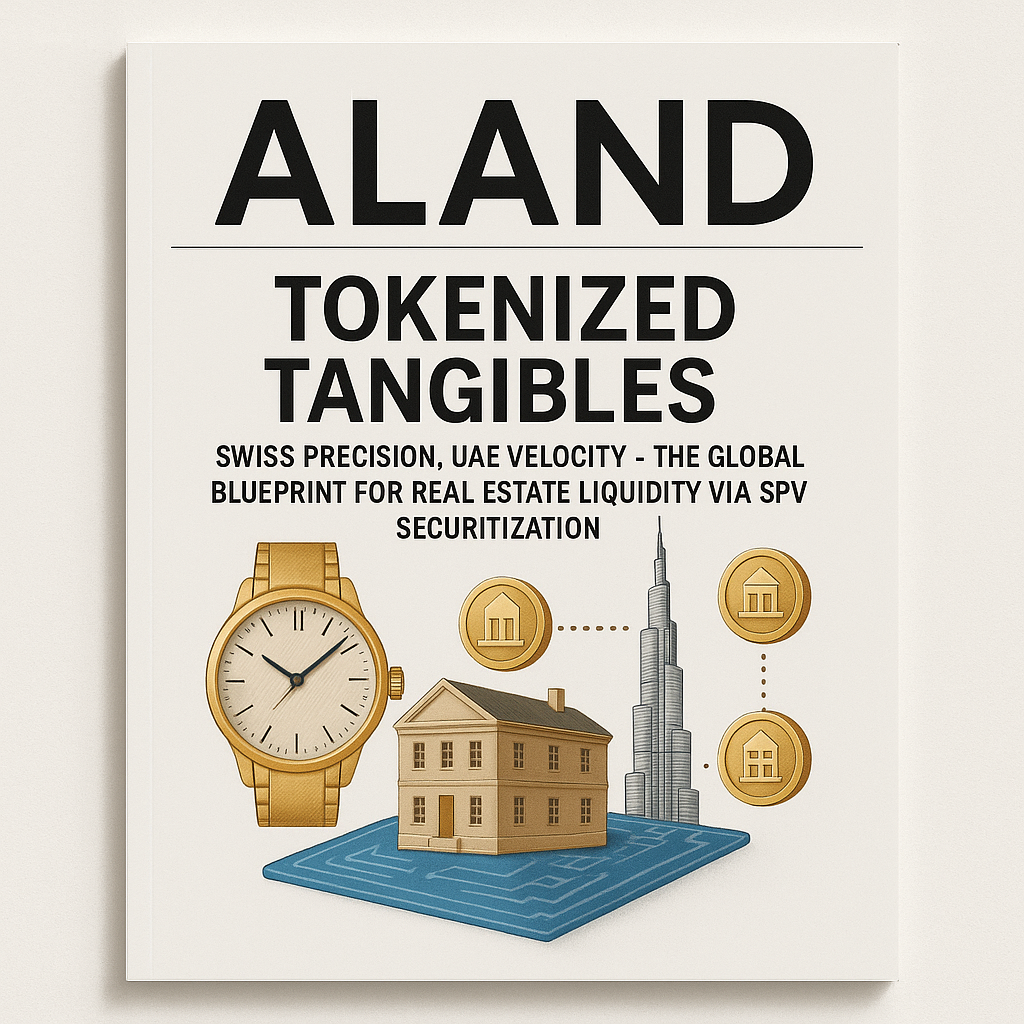
Tokenized Tangibles: Swiss Precision, UAE Velocity – The Global Blueprint for Real Estate Liquidity via SPV Securitization
- Published Date: 4th Jun, 2025
-
4.9★ ★ ★ ★ ★(145)
Listen to the Spotify Podcast for this article
By Dr. Pooyan Ghamari, Swiss Economist and Founder of the ALand Platform
The global real estate market, for all its colossal value, has long been characterized by a paradox: immense capital tied up in inherently illiquid assets. For centuries, property has been the bedrock of wealth, a tangible anchor in times of economic turbulence. Yet, the traditional mechanisms of real estate investment are cumbersome, opaque, and fraught with frictional costs, severely limiting accessibility and hindering efficient capital deployment. As a Swiss economist deeply immersed in global finance and the evolving digital economy, I posit that we are on the cusp of a profound transformation, one that marries the centuries-old strength of tangible assets with the cutting-edge efficiency of digital innovation. The answer lies in the strategic combination of tokenization and Special Purpose Vehicle (SPV) securitization, a blueprint that is finding its most potent expression in the judicious blend of Swiss precision and UAE velocity.
Bridging the Gap: Tokenization and SPV
My work with the ALand Platform has consistently highlighted the urgent need to bridge the chasm between real-world assets and the liquid demands of modern finance. Tokenization, at its core, is the process of converting rights to an asset into a digital token on a blockchain. In the context of real estate, this means representing ownership, or fractional ownership, of a property on a distributed ledger. This is not merely a digital receipt; it is a programmable, immutable record that can fundamentally alter the dynamics of how real estate is bought, sold, and managed.
The Appeal of Tokenized Real Estate
The immediate appeal of tokenized real estate is multifold. Firstly, it offers fractional ownership, democratizing access to high-value properties that were once exclusive to institutional investors or the ultra-wealthy. Imagine a prime commercial building in downtown Zurich, or a luxury residence overlooking the Dubai skyline, now divisible into thousands, or even millions, of digital tokens. Each token represents a verifiable share of the underlying asset, along with its associated rights, such as rental income or appreciation. This significantly lowers the entry barrier, allowing a broader spectrum of investors, from sophisticated high-net-worth individuals to retail participants, to diversify their portfolios with real estate.
Secondly, tokenization promises unprecedented liquidity. The traditional real estate market is notoriously illiquid, with transactions often taking months to complete due to complex legal processes, extensive due diligence, and reliance on intermediaries. Tokenized assets, traded on digital exchanges, can be bought and sold in minutes or hours, rather than weeks or months. This liquidity unlocks trapped capital, allowing investors greater flexibility and responsiveness to market conditions. For developers, this means faster capital formation and easier exits, accelerating project timelines and reducing funding costs.
The Crucial Role of Special Purpose Vehicles (SPVs)
However, the mere act of tokenizing an asset is not enough to guarantee bankability and investor protection. This is where the strategic deployment of a Special Purpose Vehicle (SPV) becomes indispensable. An SPV, typically a limited company or trust, is created for a specific, limited purpose – in this case, to hold the underlying real estate asset. The tokens issued then represent shares or claims against this SPV, rather than directly against the physical property. This structure provides a crucial layer of legal clarity, bankruptcy remoteness, and investor protection. By isolating the asset within a distinct legal entity, the SPV ring-fences it from the operational risks or financial liabilities of the issuer. This segregation of assets and liabilities is fundamental to creating truly bankable, securitized instruments that can attract institutional capital and command investor confidence.
Swiss Precision Meets UAE Velocity: A Strategic Partnership
The choice of jurisdiction for establishing these SPVs and operating tokenization platforms is not incidental; it is a strategic imperative that dictates the success and scalability of such ventures. This is precisely where the complementary strengths of Swiss precision and UAE velocity come into play, forming a powerful global blueprint.
Switzerland, a nation synonymous with financial stability, regulatory foresight, and robust legal frameworks, offers the "precision" critical for novel financial instruments. Its long-standing reputation for protecting property rights, enforcing contracts, and maintaining a transparent financial ecosystem provides a bedrock of trust. Swiss financial regulators, notably FINMA, have taken a progressive yet prudent approach to blockchain and digital assets, issuing clear guidelines and fostering an environment conducive to innovation without compromising investor protection. Establishing an SPV in Switzerland for real estate tokenization can offer investors the confidence derived from Swiss legal certainty, a strong banking sector, and a sophisticated financial infrastructure. This precision ensures that the underlying legal rights are meticulously defined, the securitization process adheres to the highest standards, and dispute resolution mechanisms are well-established.
Conversely, the United Arab Emirates, particularly Dubai, embodies "velocity" – a dynamic, forward-thinking approach characterized by rapid adoption of new technologies, pro-business policies, and an aggressive drive to become a global hub for innovation and capital. The UAE's free zones, such as the Dubai International Financial Centre (DIFC) and Abu Dhabi Global Market (ADGM), have established comprehensive legal frameworks and independent regulators (DFSA, FSRA) that are specifically tailored for digital assets and financial innovation. These jurisdictions offer common law frameworks, 100% foreign ownership, and a zero-tax environment, making them exceptionally attractive for launching and operating tokenization platforms and SPVs. The speed of regulatory approvals, the access to a vast pool of international investors, and the government's strong commitment to fostering a digital economy provide unparalleled agility and growth potential. As the founder of the ALand Platform, I have witnessed firsthand the UAE's unparalleled commitment to creating environments where innovation can flourish, making it an ideal proving ground for this new paradigm of real estate investment.
The Synergistic Model in Action
The synergy is compelling: Swiss precision provides the rigorous legal and regulatory foundation that instills global investor confidence, while UAE velocity offers the agile, business-friendly environment necessary for rapid deployment, scaling, and market access. A tokenized real estate project could, for instance, have its underlying SPV domiciled in a Swiss jurisdiction to leverage its legal robustness, while the issuance and trading platform could be established within a UAE free zone to capitalize on its digital asset-friendly regulations and global investor network. This strategic dual-jurisdiction approach maximizes both security and scalability.
Expanding Horizons: New Financial Products and Transparency
This global blueprint extends beyond mere fractional ownership. It opens doors to novel financial products and strategies. Imagine real estate-backed stablecoins, allowing property value to be a secure anchor for digital currencies. Consider debt securitization through tokenization, enabling developers to raise capital by issuing tokens backed by future rental income streams. Furthermore, the inherent transparency of blockchain technology can drastically reduce fraud and enhance due diligence, making cross-border real estate transactions more secure and efficient. This also has profound implications for combating illicit financial flows, as the immutable ledger provides an auditable trail of ownership and transactions.
Benefits for Investors and Policymakers
For high-net-worth investors and institutions, this paradigm offers new avenues for portfolio diversification and yield generation, while mitigating the liquidity risk traditionally associated with real estate. For policymakers, it presents an opportunity to stimulate economic growth, attract foreign investment, and foster financial inclusion by democratizing access to a stable asset class.
Challenges and the Path Forward
The implementation of this blueprint is not without its challenges. Interoperability between different blockchain networks, the development of robust secondary markets for tokenized assets, and the ongoing evolution of regulatory frameworks across jurisdictions remain critical hurdles. Valuation standards for fractionalized digital assets also need further maturation to ensure consistent and reliable pricing. However, the momentum is undeniable. We are seeing a growing number of pilot projects, regulatory sandboxes, and collaborative initiatives between traditional financial institutions and blockchain innovators, all converging towards this future.
In essence, the future of real estate investment is liquid, digital, and globally interconnected. It is a future where the tangible strength of property is amplified by the power of tokens and the strategic clarity of SPVs. The confluence of Swiss precision and UAE velocity offers a compelling, practical, and globally scalable model for achieving this vision. As the world navigates increasing economic complexity, the ability to transform static assets into dynamic, tradable instruments will be a decisive factor in unlocking new waves of capital and driving sustainable economic development worldwide. This blueprint is not just theoretical; it is a tangible path to a more efficient, inclusive, and resilient global real estate market.
Dr. Pooyan Ghamari’s Biography
Dr. Pooyan Ghamari is a Swiss Economist, Global Thought Leader, and the Founder of the ALand Platform. With extensive expertise in macroeconomics, real estate investments, and international finance, he has built a reputation as a key influencer in global economic strategy. His work explores emerging financial trends, digital economies, and investment opportunities in high-growth markets.
As a recognized authority in real estate and immigration markets, Dr. Ghamari provides expert insights on global property investments, economic development policies, and strategic wealth-building approaches. His analysis has shaped high-value investment strategies for governments, institutions, and private investors worldwide.
He is also a leading advocate for financial decentralization, digital asset integration, and sustainable economic development, frequently sharing groundbreaking insights on market transformations that impact investors, policymakers, and the global financial ecosystem.
FAQ's
1. What macroeconomic indicators are the best predictors of real estate market downturns and potential crashes?
2. How does the ongoing shift towards de-dollarization, particularly championed by the BRICS economic alliance, impact global real estate markets and investor strategies?
3. What innovative financial strategies should high-net-worth real estate investors prioritize during periods of economic uncertainty and potential downturns?
4. Beyond interest rates, how do central bank policies, including quantitative easing/tightening and macroprudential measures, subtly influence real estate affordability and pricing dynamics?
5. What are the most significant challenges and untapped opportunities in the rapidly evolving landscape of tokenized real estate investments?
6. Why do sophisticated high-net-worth individuals increasingly favor tangible real estate investments over traditional stock market exposures, especially in current economic climates?
7. Which emerging global cities are strategically positioned to become the next financial hubs for real estate investments, and what factors underpin their growth?
8. How is AI-driven market analytics fundamentally reshaping real estate investment decisions, moving beyond simple trend identification to predictive and prescriptive strategies?
9. What are the most pressing and often overlooked regulatory risks facing international real estate investors in 2025 and beyond, especially concerning digital asset integration?
10. What sophisticated role does geopolitical instability play in real estate price fluctuations, and how can investors leverage this volatility for strategic advantage?