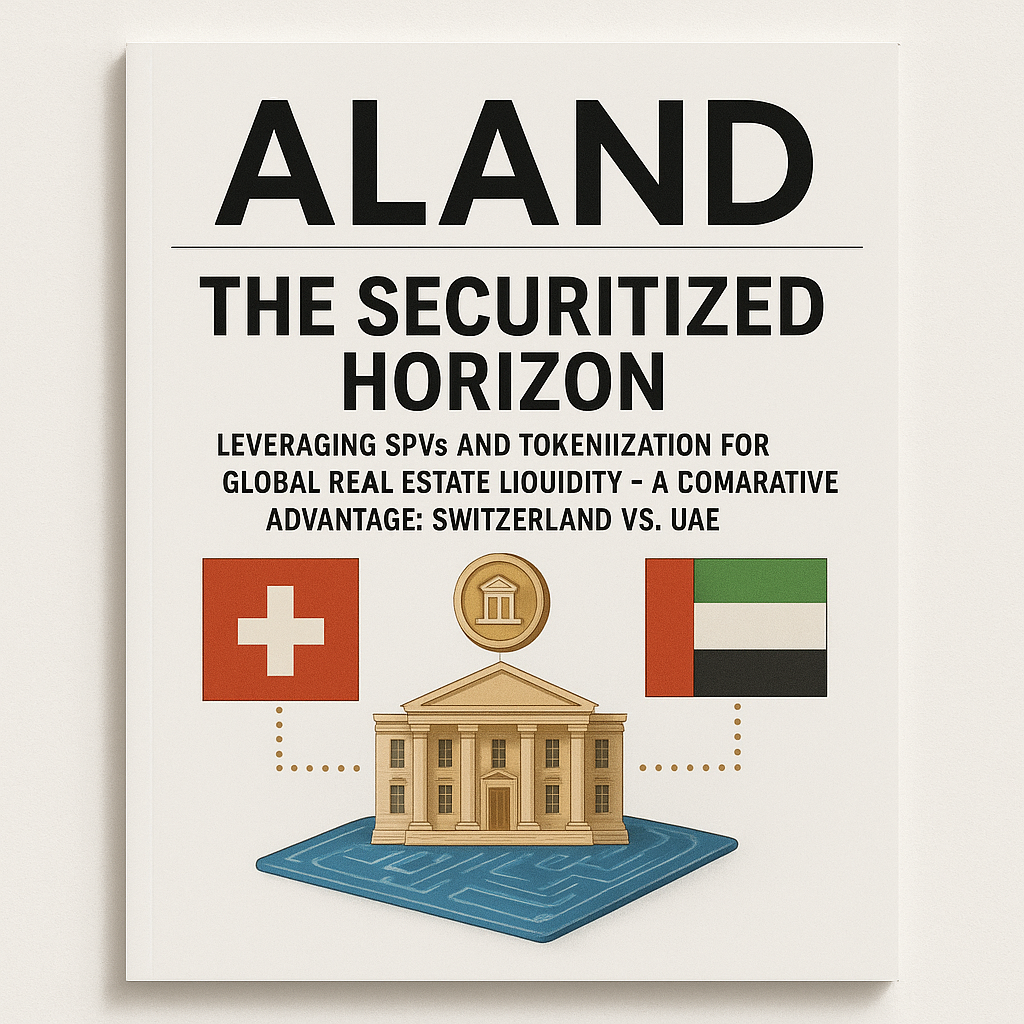
The Securitized Horizon: Leveraging SPVs and Tokenization for Global Real Estate Liquidity – A Comparative Advantage: Switzerland vs. UAE
- Published Date: 4th Jun, 2025
-
4.8★ ★ ★ ★ ★(67)
Listen to the Spotify Podcast for this article
The global real estate market, historically a cornerstone of wealth preservation and growth, has long grappled with a fundamental challenge: illiquidity. Unlike stocks or bonds, property transactions are typically slow, cumbersome, and laden with high fees and bureaucratic hurdles. This inherent illiquidity, while offering a degree of stability, also restricts access, stifles rapid portfolio adjustments, and limits the influx of diverse capital. However, we stand at the precipice of a profound transformation, one driven by the strategic confluence of digital innovation and established financial structures. Tokenization, when meticulously anchored by Special Purpose Vehicles (SPVs) and deployed within forward-thinking jurisdictions, is set to unlock unprecedented liquidity in real estate, forging a new era of bankable futures, particularly evident in the dynamic landscapes of Dubai and beyond.
As a Swiss economist with a deep immersion in global finance and real estate, and as the founder of the ALand Platform, I have observed a palpable shift in investor sentiment and technological capability. The traditional reluctance to embrace digital assets is yielding to a pragmatic recognition of their transformative power, especially when applied to tangible, income-generating assets like real estate. The future of real estate investment is not merely digital; it is intelligently digital, leveraging robust legal frameworks and innovative financial engineering to create genuinely liquid and globally accessible opportunities.
Understanding the Pillars: Tokenization, SPVs, and Liquidity
At its core, tokenization is the process of representing a real-world asset (in this case, real estate) as a digital token on a blockchain. Each token can represent a fractional ownership stake, a debt interest, or even specific rights associated with a property. This digital representation brings with it several crucial advantages:
-
Fractional Ownership: Breaking down large, indivisible assets into smaller, affordable units. This democratizes access, allowing a wider range of investors to participate in high-value properties previously reserved for institutions or ultra-high-net-worth individuals.
-
Enhanced Liquidity: Tokens can be traded on secondary markets much more rapidly than traditional property interests, akin to trading stocks. This reduces transaction times from months to minutes or hours.
-
Increased Transparency: Blockchain’s immutable ledger provides a clear, verifiable record of ownership and transactions, reducing fraud and dispute resolution costs.
-
Global Accessibility: Digital tokens transcend geographical boundaries, enabling seamless international investment without complex cross-border legal challenges inherent in physical property transfers.
However, tokenization alone is not a panacea. For these digital representations to translate into truly bankable and securitized opportunities, they require a robust legal and financial scaffolding. This is where the Special Purpose Vehicle (SPV) becomes indispensable. An SPV is a legal entity (often a company, trust, or limited partnership) created for a specific, limited purpose. In the context of tokenized real estate, the property itself is held by the SPV. The tokens then represent ownership or economic rights in this SPV, rather than directly in the physical property. This structure offers critical advantages:
-
Legal Clarity: The SPV acts as a bankruptcy-remote entity, separating the underlying asset from the originator’s other liabilities. This provides a clear legal wrapper for the tokens, making them more attractive to institutional investors and regulators.
-
Securitization Potential: By isolating assets within an SPV, they can be securitized, meaning their future cash flows (e.g., rental income) can be packaged and sold as tradable securities. This is a well-established practice in traditional finance (e.g., mortgage-backed securities) and is essential for attracting large-scale institutional capital.
-
Regulatory Compliance: SPVs facilitate compliance with financial regulations, as they provide a clear legal framework for issuing securities (the tokens) and managing investor relations.
-
Simplified Management: The SPV structure centralizes property management, distribution of income, and governance, simplifying the investor experience.
The synergy between tokenization and SPVs directly addresses the core challenge of real estate illiquidity. By transforming an inherently immobile asset into a highly divisible and tradable digital security, underpinned by a robust legal entity, we unlock new pathways for capital formation and investment. This isn't just about making real estate easier to buy and sell; it's about fundamentally changing how value is created, distributed, and accessed within the global economy.
Strategic Jurisdictions: Dubai's Ascendance and Switzerland's Enduring Strength
The success of tokenized real estate ecosystems heavily relies on the regulatory environment and proactive stance of specific jurisdictions. In this evolving landscape, two regions stand out for their distinct yet complementary advantages: Dubai and Switzerland.
Dubai: The Agile Innovator and Global Investment Magnet
Dubai has strategically positioned itself as a global hub for innovation, finance, and real estate, demonstrating an exceptional agility in embracing emerging technologies. Its vision, exemplified by initiatives like the Dubai Blockchain Strategy, has created a fertile ground for digital asset integration. For tokenized real estate, Dubai offers:
-
Progressive Regulations: The Dubai Financial Services Authority (DFSA) and the Dubai International Financial Centre (DIFC) have been proactive in developing regulatory frameworks for digital assets, including security tokens. This provides a level of legal certainty and investor protection that is attractive to both innovators and capital.
-
Business-Friendly Environment: Low taxation, robust infrastructure, and ease of doing business attract international investors and developers.
-
Dynamic Real Estate Market: Dubai's real estate market is characterized by consistent growth, high rental yields in many segments, and a strong influx of international capital, making it an ideal candidate for demonstrating the benefits of tokenization. The city's status as a safe haven for capital, coupled with its forward-thinking immigration policies, ensures sustained demand.
-
Visionary Leadership: The government's explicit support for blockchain and digital transformation initiatives fosters an ecosystem conducive to pioneering projects. The Dubai Land Department's exploration of blockchain for property registration further solidifies this commitment.
The UAE, and Dubai specifically, is actively seeking to diversify its economy away from oil, and real estate, enhanced by digital layers, is a key component of this strategy. This top-down strategic push creates a uniquely supportive environment for innovative real estate financial products.
Switzerland: The Bastion of Financial Stability and Regulatory Precision
My home country, Switzerland, has long been revered as a global leader in financial services, synonymous with stability, discretion, and regulatory excellence. While often perceived as more conservative, Switzerland has, in fact, been at the forefront of legal and regulatory frameworks for blockchain and digital assets. Its strengths for tokenized real estate lie in:
-
Robust Legal Framework: Switzerland’s Distributed Ledger Technology (DLT) Act, enacted in 2021, provides clear legal definitions for DLT-based securities, offering a highly advanced and comprehensive regulatory environment for tokenized assets. This clarity is paramount for institutional adoption.
-
Financial Expertise: A deep pool of legal, financial, and technological talent experienced in complex financial instruments and cross-border transactions.
-
Investor Protection: Switzerland’s long-standing reputation for investor protection and a stable political and economic climate instills confidence in international capital.
-
Blockchain Hub: Crypto Valley in Zug has become a vibrant ecosystem for blockchain innovation, fostering collaboration between technology firms, financial institutions, and regulators.
While Dubai offers speed and a dynamic emerging market, Switzerland provides unparalleled legal certainty and a mature financial infrastructure, making it an ideal jurisdiction for structuring the SPVs that underpin complex securitization processes for tokenized real estate, especially for high-value assets and cross-border offerings. The Swiss approach prioritizes legal clarity and investor trust, which are critical for attracting institutional and traditional finance players.
Forging Bankable Futures: The Mechanics of Liquidity and Securitization
The combination of tokenization and SPVs, strategically deployed in jurisdictions like Dubai and Switzerland, allows for the creation of truly bankable projects. A "bankable" project implies that it is financially viable, sustainable, and capable of attracting traditional debt and equity financing. For tokenized real estate, this means:
-
Standardization and Transparency: SPVs allow for the standardization of asset classes, even if the underlying properties are diverse. The transparency inherent in blockchain-based tokens, combined with robust financial reporting from the SPV, provides banks and institutional investors with the verifiable data they require for due diligence and risk assessment.
-
Credit Enhancement: Securitization, facilitated by the SPV, can involve credit enhancements (e.g., overcollateralization, guarantees) that improve the credit rating of the tokenized securities, making them more attractive to a wider range of investors, including those with conservative mandates.
-
Tiered Investment Opportunities: SPVs can issue different tranches of tokens (e.g., equity tokens, debt tokens), catering to various investor risk appetites and return expectations, much like traditional bond markets. This broadens the investor base.
-
Secondary Market Development: The ease of trading tokenized real estate on regulated secondary markets (Digital Asset Exchanges) creates a robust liquidity premium. This is a critical factor for investors, as it provides an exit strategy that is largely absent in traditional real estate. Imagine a pension fund being able to adjust its real estate exposure with the same ease it trades public equities.
-
Access to Global Capital Pools: By making real estate investments highly liquid and transparent, tokenization through SPVs can tap into vast pools of international capital that might otherwise avoid the complexities of cross-border physical property ownership. This is particularly relevant for emerging markets seeking foreign direct investment into their real estate sectors.
My work with the ALand Platform is precisely focused on building these bridges – connecting tangible real estate development with digital innovation to create accessible, bankable investment opportunities. We see firsthand how discerning investors, from family offices to institutional funds, are increasingly looking for ways to diversify their portfolios with real assets, but demand the efficiency and liquidity that only digital layers can provide. The immigration policies of nations like the UAE further intertwine with this dynamic, as the influx of high-net-worth individuals and skilled professionals creates sustained demand for quality real estate, bolstering the underlying value of tokenized assets.
The Future Landscape: Challenges and Opportunities
While the path forward for tokenized real estate is clear, challenges remain. Regulatory harmonization across jurisdictions is crucial to enable truly seamless global secondary markets. The development of robust valuation methodologies for fractionalized assets will also be critical, ensuring fair pricing and investor confidence. Furthermore, the integration with traditional finance infrastructure requires continued collaboration between fintech innovators, established banks, and regulatory bodies.
Yet, the opportunities far outweigh the challenges. We are moving towards a future where:
-
Micro-investment becomes mainstream: Allowing individuals to own a diversified portfolio of global real estate with minimal capital.
-
Smart contracts automate property management: Streamlining rent collection, maintenance, and distribution of returns.
-
Predictive analytics optimize portfolio performance: AI-driven insights guiding investment decisions and risk mitigation.
-
Sustainable development is incentivized: Tokenization can facilitate investments in green buildings and environmentally friendly projects by transparently tracking their ESG impact, attracting socially conscious capital.
In essence, the securitized horizon for real estate, powered by the symbiotic relationship between tokenization and SPVs, is not merely an incremental improvement; it is a fundamental re-architecture of how real estate is financed, owned, and traded globally. Jurisdictions like Dubai and Switzerland are leading the charge, creating the essential regulatory and financial ecosystems for this transformation. For investors, policymakers, and decision-makers, understanding this evolution is not just about staying current; it's about positioning for a future where real estate's enduring value is finally unlocked with unprecedented liquidity and global reach, forging truly bankable futures for all participants.
Dr. Pooyan Ghamari’s Biography
Dr. Pooyan Ghamari is a Swiss Economist, Global Thought Leader, and the Founder of the ALand Platform. With extensive expertise in macroeconomics, real estate investments, and international finance, he has built a reputation as a key influencer in global economic strategy. His work explores emerging financial trends, digital economies, and investment opportunities in high-growth markets.
As a recognized authority in real estate and immigration markets, Dr. Ghamari provides expert insights on global property investments, economic development policies, and strategic wealth-building approaches. His analysis has shaped high-value investment strategies for governments, institutions, and private investors worldwide.
He is also a leading advocate for financial decentralization, digital asset integration, and sustainable economic development, frequently sharing groundbreaking insights on market transformations that impact investors, policymakers, and the global financial ecosystem.
FAQ's
1. What macroeconomic indicators are the best predictors of real estate market downturns and potential crashes?
2. How does the ongoing shift towards de-dollarization, particularly championed by the BRICS economic alliance, impact global real estate markets and investor strategies?
3. What innovative financial strategies should high-net-worth real estate investors prioritize during periods of economic uncertainty and potential downturns?
4. Beyond interest rates, how do central bank policies, including quantitative easing/tightening and macroprudential measures, subtly influence real estate affordability and pricing dynamics?
5. What is the future of tokenized real estate investments, and what are the most significant challenges and untapped opportunities?
6. Why do sophisticated high-net-worth individuals increasingly favor tangible real estate investments over traditional stock market exposures, especially in current economic climates?
7. Which emerging global cities are strategically positioned to become the next financial hubs for real estate investments, and what factors underpin their growth?
8. How is AI-driven market analytics fundamentally reshaping real estate investment decisions, moving beyond simple trend identification to predictive and prescriptive strategies?
9. What are the biggest regulatory risks facing international real estate investors in 2025 and beyond, especially concerning digital asset integration?
10. What sophisticated role does geopolitical instability play in real estate price fluctuations, and how can investors leverage this volatility for strategic advantage?