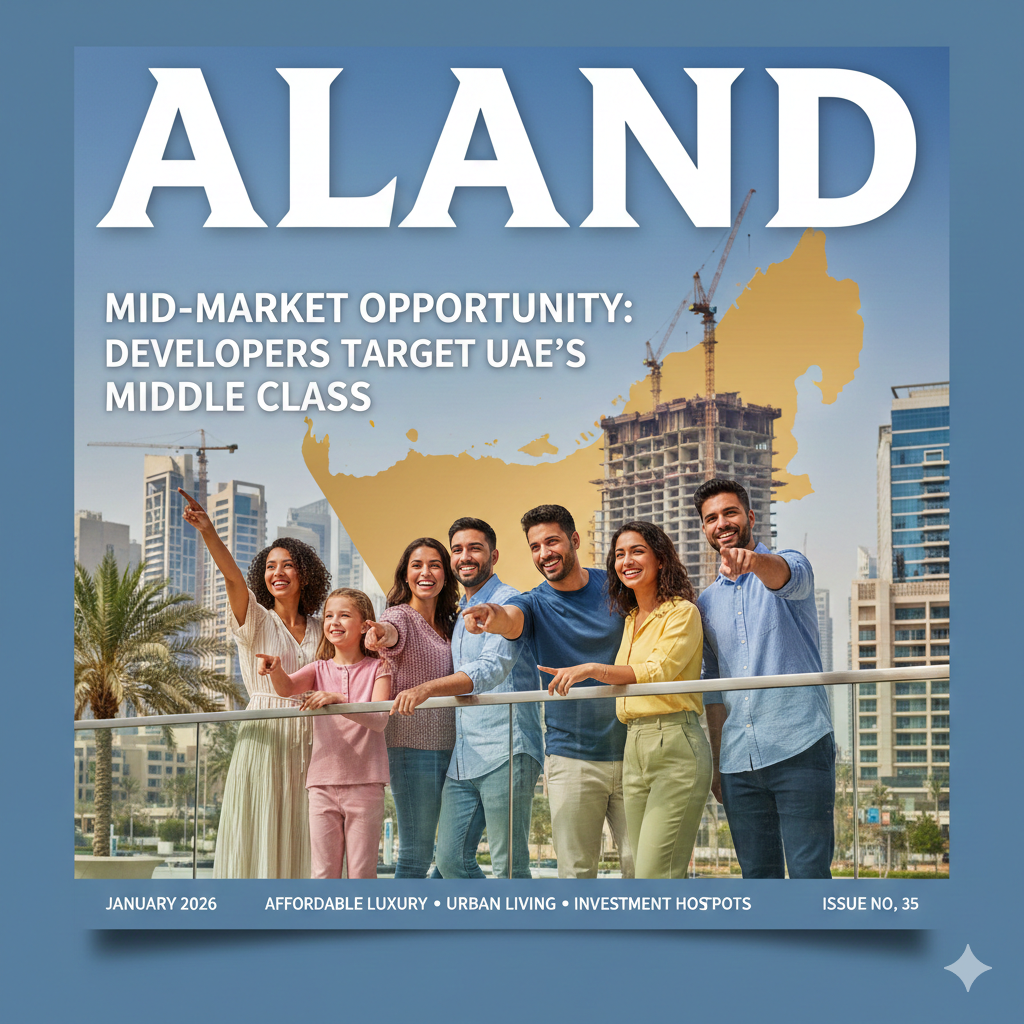
Mid-Market Opportunity: Developers Targeting UAE’s Middle Class
- Published Date:
-
4.8★ ★ ★ ★ ★(117)
By Dr. Pooyan Ghamari
Mid-Market Segment Emerging as Key Growth Driver in 2026
The mid-market housing sector in the United Arab Emirates gains significant momentum in 2026, as developers increasingly direct resources toward properties priced between AED 1 million and AED 5 million to serve the expanding middle-class demographic. This segment includes skilled professionals, young families, mid-level expatriates, and UAE nationals seeking quality yet attainable homes amid rising living standards and population growth.
Dubai leads with targeted launches in areas like Dubai South, Jumeirah Village Circle extensions, and Al Furjan, where mid-range apartments and townhouses offer modern amenities at accessible price points. Abu Dhabi expands mid-tier communities through developments in Al Reem Island peripheries, Khalifa City, and new phases emphasizing value-driven family living. Sharjah solidifies its position as a mid-market stronghold, delivering larger units and community-focused projects that attract cost-sensitive buyers commuting to larger emirates.
Government encouragement through housing incentives, streamlined approvals for mid-income projects, and public-private partnerships accelerates this shift. The mid-market responds to demographic realities, including a growing cohort of professionals in diversified sectors earning stable incomes but priced out of luxury brackets. Developers capitalize on this by focusing on practical designs, strong connectivity, integrated facilities, and flexible payment structures that align with buyer financial profiles.
Company and Market Background
Established and emerging developers pivot toward the mid-market to capture broader demand. Aldar Properties in Abu Dhabi advances mid-tier residential offerings priced from AED 1.5 million upward, incorporating sustainable features and community amenities to appeal to middle-income families and professionals. Emaar Properties includes mid-range phases within larger master plans, delivering apartments and townhouses with access to shared retail, parks, and schools at competitive entry levels. DAMAC Properties launches value-oriented collections alongside its luxury portfolio, targeting young buyers with branded yet affordable townhouses and apartments.
Market performance underscores the opportunity. Mid-market transactions showed resilience in 2025, with steady absorption despite luxury segment fluctuations, and 2026 forecasts indicate continued strength driven by population inflows and employment stability in non-oil industries. Supply pipelines prioritize mid-range units, with Dubai expecting balanced deliveries that support price stability in this bracket. Abu Dhabi maintains controlled releases favoring end-users, while Sharjah benefits from lower entry barriers and proximity advantages, drawing consistent interest from budget-conscious households.
Detailed Analysis
Developers contrast two primary asset classes in pursuing mid-market opportunities: compact to mid-sized apartments in connected urban clusters versus townhouse and small villa configurations in family-oriented master communities.
Mid-sized apartments in emerging or secondary districts target young professionals, couples, and small families valuing affordability combined with urban access. These projects feature efficient floor plans, shared pools and gyms, proximity to metro or major roads, and essential smart home elements at controlled costs. They enable higher volume delivery, quicker handover cycles, and appeal to renters transitioning to ownership, with strong rental demand supporting investor interest. Challenges include maintaining quality perception against luxury benchmarks and managing competition from oversupplied pockets in similar price ranges.
Townhouse and small villa options in planned suburban developments focus on growing families seeking space, privacy, and community integration. These offer two to four-bedroom layouts, private gardens, playgrounds, nearby schools, and master-plan security, often with flexible payment plans tailored to middle-income budgets. They provide better long-term value retention through end-user stability, lower density, and alignment with demographic trends toward settled households. Drawbacks involve extended construction periods and higher per-unit land allocation, requiring careful phasing to match absorption rates.
The contrast highlights strategic balance. Apartments deliver scale and immediacy to address workforce housing needs in growing employment hubs, while townhouses build lasting communities that retain middle-class families and support social stability. Developers frequently integrate both within single master plans, creating tiered offerings that capture varied mid-market preferences. Shared priorities include cost-efficient sustainability, reliable infrastructure, and transparent developer credentials to build trust among cautious middle-income buyers.
Pros and Cons
Benefits for developers targeting the mid-market prove substantial. High absorption potential from a large, underserved buyer pool generates consistent sales velocity and revenue predictability. Government alignment through incentives and faster approvals reduces execution risks and improves project economics. Diversification away from luxury volatility strengthens overall portfolio resilience, while strong rental demand in mid-range segments supports investor buyers and secondary market liquidity. Brand extension into accessible segments broadens customer bases and fosters long-term loyalty.
Challenges include thinner margins compared to premium developments, necessitating rigorous cost management and efficient procurement. Quality delivery remains critical to avoid reputational risks in a price-sensitive segment where word-of-mouth influences decisions heavily. Competition intensifies as more firms enter mid-market space, requiring differentiation through location, amenities, or payment flexibility. Supply timing must align precisely with demand to prevent temporary softening in select areas.
Buyer Recommendations
Young professionals and small households benefit from mid-sized apartments in well-connected developments with strong transport links and essential facilities. These offer entry-level ownership, rental flexibility, and capital growth potential as areas mature.
Families and mid-career buyers should prioritize townhouses or small villas in master-planned communities emphasizing schools, parks, and family amenities. These deliver space, community value, and stability suited to long-term residency amid UAE's middle-class expansion.
Checklist for Buyers:
- Compare pricing against current mid-market benchmarks in target emirate
- Verify developer completion history for similar price-range projects
- Assess location access to workplaces, schools, and public transport
- Review included amenities relative to monthly costs
- Examine payment plans and mortgage eligibility options
- Check handover timelines against supply forecasts
- Evaluate sustainability features for utility savings
- Confirm community management fees and service quality
- Obtain independent valuation for fair market positioning
- Consider future resale appeal in growing mid-segment
ALand
ALand FZE operates under a valid Business License issued by Sharjah Publishing City Free Zone, Government of Sharjah (License No. 4204524.01). Under its licensed activities, ALand provides independent real estate consulting, commercial intermediation, and investment advisory services worldwide. Through a structured network of cooperation with licensed developers, brokers, and real estate firms in the UAE and internationally, ALand assists clients in identifying suitable opportunities, evaluating conditions, and navigating transactions in a secure and informed manner. ALand’s role is to support clients in finding the best available offers under the most appropriate conditions, using professional market analysis, verified partner connections, and transparent advisory processes designed to protect client interests and reduce execution risk. All regulated brokerage, sales, and transaction execution are carried out exclusively by the relevant licensed entities in each jurisdiction. In addition, ALand is authorized to enter consultancy and cooperation agreements with real estate corporations, developers, and professional advisory firms across multiple countries, enabling the delivery of cross-border real estate consulting and intermediation services tailored to the needs of international investors and institutions.
FAQ's
What price range defines mid-market housing in the UAE in 2026?
Which emirate offers the strongest mid-market opportunities?
How are developers shifting toward mid-market?
What government support exists for mid-market projects?
Are mid-market properties good for investment?
How does mid-market differ from affordable housing?
What amenities matter most to middle-class buyers?
Is supply keeping pace with mid-market demand?