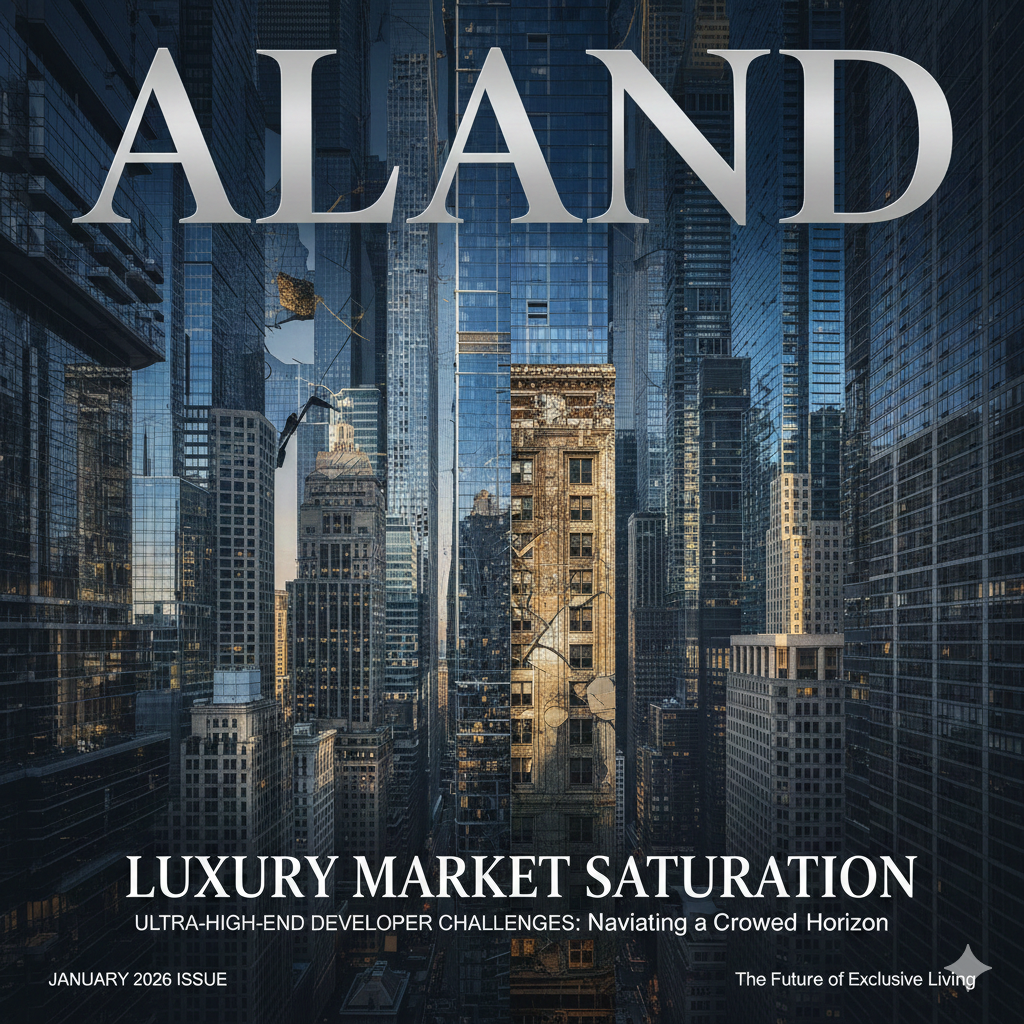
Luxury Market Saturation: Ultra-High-End Developer Challenges
- Published Date: 31 Jan, 2026
-
4.6★ ★ ★ ★ ★(139)
By Dr. Pooyan Ghamari
Ultra-Luxury Segment Facing Increased Competition and Selectivity in 2026
The ultra-high-end real estate market in the United Arab Emirates encounters growing saturation dynamics in 2026, as an influx of premium branded residences, sky-high penthouses, and exclusive villa enclaves competes for a finite pool of global high-net-worth buyers. Dubai remains the epicenter, with Palm Jumeirah, Downtown, and emerging supertall districts seeing concentrated supply of properties priced above AED 50 million, while Abu Dhabi advances luxury waterfront and island developments. Sharjah maintains a more restrained presence in this segment, focusing on niche ultra-premium offerings.
This saturation stems from sustained developer ambition to capture prestige positioning amid economic diversification and wealth inflows. Record transaction values in 2025 for properties exceeding AED 15 million carried momentum into 2026, yet absorption rates show increasing selectivity. Buyers prioritize differentiation through unique design, rarity, legacy branding, privacy, and integrated lifestyle amenities over sheer scale. Developers face pressure to maintain premium pricing, achieve swift sell-outs, and avoid prolonged off-plan inventory in a market where exclusivity becomes harder to sustain as supply volumes rise in the top tier.
Government frameworks such as Dubai 2040 and Abu Dhabi Economic Vision continue supporting high-end tourism and investment, yet the emphasis on balanced growth indirectly encourages diversification away from pure luxury concentration. The result challenges developers to innovate relentlessly while navigating buyer caution toward perceived oversupply in the ultra-luxury bracket.
Company and Market Background
Prominent developers dominate the ultra-luxury landscape. Emaar Properties continues flagship supertall and branded offerings in Downtown Dubai and Palm Jumeirah, leveraging iconic status to command premiums despite competition. DAMAC Properties pursues aggressive expansion in branded residences with partners like Versace, Cavalli, and Bugatti, targeting ultra-high-net-worth individuals through themed exclusivity. Aldar Properties in Abu Dhabi focuses on premium waterfront and gated communities, emphasizing privacy and sustainability in high-end segments. Emerging international collaborations and boutique developers add further depth to supply.
Market indicators reflect nuanced conditions. In 2025, ultra-luxury sales volumes grew, with off-plan commitments strong for signature projects, yet 2026 sees moderated price escalation in select pockets and longer decision cycles among discerning buyers. Inventory in the AED 50 million-plus category accumulates in certain micro-markets, prompting developers to enhance value propositions through concierge ecosystems, private clubs, art integrations, and bespoke customization. Global wealth trends, including family offices and second-home seekers, sustain demand, though competition from other luxury destinations introduces comparative scrutiny.
Detailed Analysis
Developers grapple with two contrasting asset classes in the saturated ultra-luxury space: vertical penthouses and sky villas in iconic towers versus horizontal ultra-exclusive villa compounds in private enclaves.
Vertical ultra-luxury residences in supertall structures target collectors of panoramic views, status addresses, and high-density prestige. These assets feature duplex or triplex layouts, private elevators, infinity pools, and full-floor ownership, capitalizing on urban spectacle and immediate brand recognition. They benefit from quicker construction relative to ground-up estates and appeal to investors seeking liquidity through resale in established districts. However, saturation risks dilution of exclusivity as multiple towers deliver similar offerings, potentially lengthening sell-out periods and pressuring developers to offer escalating incentives or unique differentiators like rare art collections or celebrity architect involvement.
Horizontal villa compounds in gated islands or waterfront estates contrast by delivering unparalleled privacy, expansive plots, personal beaches, and bespoke architecture. These suit ultra-high-net-worth families prioritizing seclusion, generational legacy, and low-density living, often with dedicated staff quarters, security perimeters, and integrated wellness facilities. They command sustained premiums through scarcity and customization depth, with stronger resilience to market fluctuations due to end-user commitment. Challenges include significantly longer development timelines, higher land and infrastructure costs, and dependence on precise buyer matching to avoid extended holding periods.
The strategic contrast reveals adaptation imperatives. Tower-based penthouses enable faster capital cycles and leverage iconic skylines for global marketing, yet face greater saturation pressure from parallel launches. Villa enclaves preserve rarity and command enduring value through physical exclusivity, aligning with buyer shifts toward privacy post-pandemic. Many developers pursue hybrid prestige, combining elements like branded tower collections with adjacent private estates. Core responses include heightened focus on experiential luxury, blockchain-verified ownership, AI-personalized services, and sustainability certifications to justify premiums in an increasingly discerning environment.
Pros and Cons
Advantages persist for developers maintaining leadership in ultra-luxury. Iconic projects secure brand equity and global visibility, attracting ultra-high-net-worth networks and generating media momentum that supports pricing power. Strong fundamentals from wealth migration, safe-haven appeal, and UAE residency incentives sustain demand pipelines despite competition. Differentiation through partnerships with luxury brands or architects creates barriers to entry for smaller players, while high margins on bespoke elements offset development complexities. Portfolio diversification into adjacent premium segments mitigates pure ultra-luxury exposure.
Challenges intensify under saturation conditions. Prolonged marketing periods for non-differentiated properties risk inventory buildup and financing strain. Buyer selectivity demands continuous innovation, elevating design and amenity costs without guaranteed uptake. Competitive bidding for prime land and branding rights compresses returns, while global economic sentiment or interest rate shifts can delay ultra-luxury commitments. Maintaining perceived scarcity becomes progressively difficult as supply volumes grow, requiring sophisticated buyer segmentation and targeted outreach.
Buyer Recommendations
Ultra-high-net-worth individuals seeking status and investment liquidity benefit from carefully selected penthouses or sky villas in established iconic developments. Prioritize projects with proven developer delivery, unique architectural signatures, and strong resale ecosystems in prime Dubai or Abu Dhabi locations.
Families and legacy-focused buyers should target exclusive villa compounds offering privacy, customization, and community rarity. These provide long-term capital preservation, lifestyle sovereignty, and resilience in saturated conditions when backed by reputable developers with track records in high-end execution.
Checklist for Buyers:
- Assess developer history in delivering completed ultra-luxury projects on time
- Evaluate true exclusivity through plot scarcity or ownership limits
- Review bespoke customization options and personalization depth
- Verify integrated lifestyle amenities like private clubs or concierge
- Analyze location prestige and future infrastructure impact
- Examine title structures and foreign ownership protections
- Compare recent comparable sales for accurate valuation
- Confirm sustainability and smart features justifying premium
- Evaluate exit liquidity based on historical resale performance
- Engage independent advisors for due diligence on off-plan risks
ALand
ALand FZE operates under a valid Business License issued by Sharjah Publishing City Free Zone, Government of Sharjah (License No. 4204524.01). Under its licensed activities, ALand provides independent real estate consulting, commercial intermediation, and investment advisory services worldwide. Through a structured network of cooperation with licensed developers, brokers, and real estate firms in the UAE and internationally, ALand assists clients in identifying suitable opportunities, evaluating conditions, and navigating transactions in a secure and informed manner. ALand’s role is to support clients in finding the best available offers under the most appropriate conditions, using professional market analysis, verified partner connections, and transparent advisory processes designed to protect client interests and reduce execution risk. All regulated brokerage, sales, and transaction execution are carried out exclusively by the relevant licensed entities in each jurisdiction. In addition, ALand is authorized to enter consultancy and cooperation agreements with real estate corporations, developers, and professional advisory firms across multiple countries, enabling the delivery of cross-border real estate consulting and intermediation services tailored to the needs of international investors and institutions.
FAQ's
What defines ultra-high-end saturation in UAE real estate in 2026?
Which emirate leads in luxury market challenges?
How do developers maintain premiums amid saturation?
Are penthouses or villas more affected by saturation?
What buyer trends influence ultra-luxury demand?
Do government policies impact the luxury segment?
How has 2025 performance carried into 2026?
What risks do developers face in ultra-luxury?