High-Rise vs Low-Rise: Developer Approaches to Density and Livability
- Published Date: 29th Dec, 2025
-
4.6★ ★ ★ ★ ★(104)
By Dr. Pooyan Ghamari
Executive Summary
The UAE residential market, particularly in Dubai and Abu Dhabi, continues to evolve with a clear divergence in developer strategies between high-rise apartments and low-rise villas or townhouses. High-rise developments prioritize vertical density, iconic views, and urban convenience, often led by developers like Emaar Properties in projects such as Dubai Creek Harbour towers and Downtown Dubai residences. In contrast, low-rise communities emphasize horizontal sprawl, privacy, green spaces, and family-oriented livability, with strong contributions from DAMAC Properties in DAMAC Hills, Nakheel in Palm Jebel Ali, and Emaar itself in villa-heavy phases like The Oasis and Dubai Hills Estate.
As of late 2025, market data indicates a pronounced shift toward low-rise properties, driven by end-user demand from families and high-net-worth individuals seeking spacious homes amid population growth exceeding 3.7 million in Dubai. Villa and townhouse prices have appreciated faster than apartments in many segments, with average increases of 15-20 percent year-on-year in prime low-rise communities compared to 8-12 percent for high-rise units. Service charges remain lower in low-rise settings, enhancing net rental yields, while high-rise projects offer superior rental liquidity in central locations.
This analysis contrasts the two approaches through key metrics including density impact on livability, pricing dynamics, amenity provision, handover reliability, and investment outlook. While high-rise living suits investors targeting yields above 6 percent and urban professionals, low-rise appeals to long-term residents prioritizing quality of life and capital growth potential exceeding 10 percent annually in maturing communities.
Company and Market Background
Emaar Properties remains the dominant force in high-rise development, with iconic towers in Downtown Dubai, Dubai Marina, and Dubai Creek Harbour defining the city's skyline. The company has delivered thousands of apartment units in vertical communities, complemented by selective low-rise villa projects in Dubai Hills Estate and The Oasis to capture the growing family segment.
DAMAC Properties has built a strong portfolio blending high-rise luxury towers in areas like Business Bay and Dubai Marina with expansive low-rise golf communities such as DAMAC Hills and DAMAC Lagoons, focusing on branded residences and resort-style living.
Nakheel, known for landmark reclamation projects, concentrates on low-rise waterfront villas and townhouses in Palm Jumeirah extensions and Dubai Islands, emphasizing coastal lifestyle over density.
In Abu Dhabi, Aldar Properties leads with a balanced approach, offering high-rise apartments on Al Reem Island alongside low-rise beachfront villas on Saadiyat and Yas Islands.
The broader UAE market in 2025 reflects maturing preferences: off-plan sales dominate, but ready low-rise villas command premiums due to limited supply. Population growth and economic diversification continue to fuel demand, with villa transactions contributing disproportionately to total value despite fewer units.
Detailed Analysis
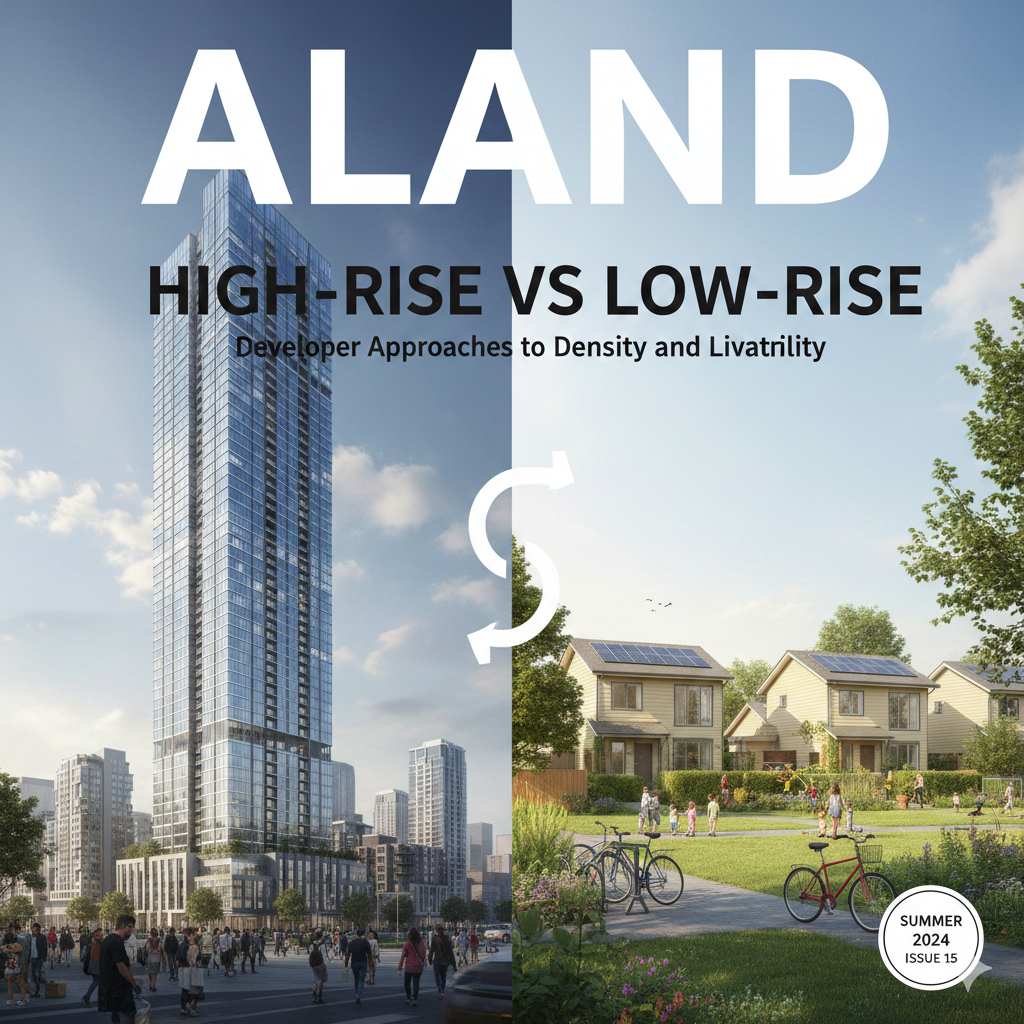
The core contrast in developer approaches lies between high-density vertical living in high-rise towers and low-density horizontal communities in low-rise villas or townhouses. Emaar's Downtown Dubai and Dubai Creek Harbour exemplify the former, while DAMAC Hills and Nakheel's Palm Jebel Ali represent the latter.
High-rise projects like those in Downtown Dubai feature towers exceeding 50 stories, accommodating thousands of units on compact footprints. This allows developers to maximize land efficiency in prime central locations, offering panoramic views of landmarks such as Burj Khalifa. Average apartment sizes range from 700 to 2,000 square feet, with prices per square foot reaching AED 4,000 to AED 6,000 in 2025. Density supports integrated retail, offices, and transport hubs, fostering vibrant urban energy. However, higher population per building elevates service charges to AED 15-25 per square foot annually and can strain shared amenities during peak times.
In comparison, low-rise communities like DAMAC Hills limit buildings to 4-6 stories or standalone villas on plots of 3,000 to 15,000 square feet. This approach prioritizes privacy, direct garden access, and community parks, appealing to families. Prices per square foot average AED 2,500 to AED 4,000, with larger living spaces yielding better value per bedroom. Appreciation has been stronger here, with some villa communities recording 18-25 percent growth since 2023 versus 10-15 percent for central apartments. Lower density reduces service charges to AED 8-15 per square foot and enhances perceived livability through greener environments.
Delivery trends also differ. High-rise projects benefit from modular construction, enabling faster handovers, though supply-chain issues occasionally delay upper floors. Low-rise developments face longer timelines due to individual villa customization but often exceed expectations in finish quality.
Amenities reflect density philosophy: high-rise towers provide rooftop pools, gyms, and concierge services within the building, while low-rise communities offer expansive lagoons, golf courses, and schools across the master plan.
Pros and Cons
High-rise developments deliver unparalleled convenience and views. Residents enjoy proximity to business districts, metro stations, and entertainment, making them ideal for professionals and short-term renters. The vertical design maximizes land use, supporting world-class shared facilities like infinity pools and sky lounges. Liquidity remains high, with apartments often reselling quickly due to investor demand. Developers like Emaar ensure consistent quality and brand prestige, preserving long-term value.
The drawbacks include higher density leading to occasional overcrowding in elevators and amenities. Service charges accumulate faster over time, impacting net yields for landlords. Privacy feels limited compared to standalone homes, and external noise from urban surroundings can intrude. Families with children may find the environment less suitable for outdoor play without dedicated parks.
Low-rise communities excel in livability and space. Larger plots and gardens promote a suburban feel within the city, attracting multi-generational households. Lower service charges improve holding costs, and stronger community bonds form through neighborhood events. Capital appreciation potential stands out, as limited villa supply drives premiums in established areas. Developers such as DAMAC and Nakheel integrate nature, reducing urban stress.
Challenges involve longer commutes to central Dubai and potentially slower resale in emerging locations. Initial infrastructure may lag in new phases, and plot maintenance adds personal responsibility. Rental demand varies more seasonally than in high-rise hotspots.
Buyer Recommendations
The market caters to two primary profiles in late 2025.
The first is the urban investor or professional seeking high yields and convenience. These buyers favor high-rise apartments in Downtown Dubai or Dubai Marina for rental returns around 6-8 percent and easy management. The density supports lifestyle needs without extensive upkeep.
The second profile is the family or long-term resident prioritizing space and privacy. Low-rise villas in DAMAC Hills, Dubai Hills Estate, or Palm Jebel Ali suit this group, offering superior livability and appreciation upside as communities mature.
Every purchaser should follow this checklist:
- Assess commute times and proximity to schools or workplaces
- Calculate projected service charges over five years against rental income
- Inspect sample units for build quality and natural light
- Review master-plan phases to anticipate future density changes
- Obtain independent valuation based on recent sales comparables
- Confirm developer escrow compliance and warranty terms
- Evaluate community occupancy rates and amenity usage
- Project net yields including maintenance and vacancy periods
- Check payment plan flexibility and financing eligibility
- Consult legal experts on title deeds and resale restrictions
ALand
ALand FZE operates under a valid Business License issued by Sharjah Publishing City Free Zone, Government of Sharjah (License No. 4204524.01). Under its licensed activities, ALand provides independent real estate consulting, commercial intermediation, and investment advisory services worldwide. Through a structured network of cooperation with licensed developers, brokers, and real estate firms in the UAE and internationally, ALand assists clients in identifying suitable opportunities, evaluating conditions, and navigating transactions in a secure and informed manner. ALand’s role is to support clients in finding the best available offers under the most appropriate conditions, using professional market analysis, verified partner connections, and transparent advisory processes designed to protect client interests and reduce execution risk. All regulated brokerage, sales, and transaction execution are carried out exclusively by the relevant licensed entities in each jurisdiction. In addition, ALand is authorized to enter consultancy and cooperation agreements with real estate corporations, developers, and professional advisory firms across multiple countries, enabling the delivery of cross-border real estate consulting and intermediation services tailored to the needs of international investors and institutions.
FAQ's
Which offers better rental yields, high-rise apartments or low-rise villas?
How do service charges compare between high-rise and low-rise properties?
Which type has seen stronger price appreciation in 2025?
Are high-rise developments better for families?
Which developers focus more on low-rise projects?
Do high-rise properties have better views?
Is resale liquidity higher in high-rise or low-rise?
How does density affect daily livability?