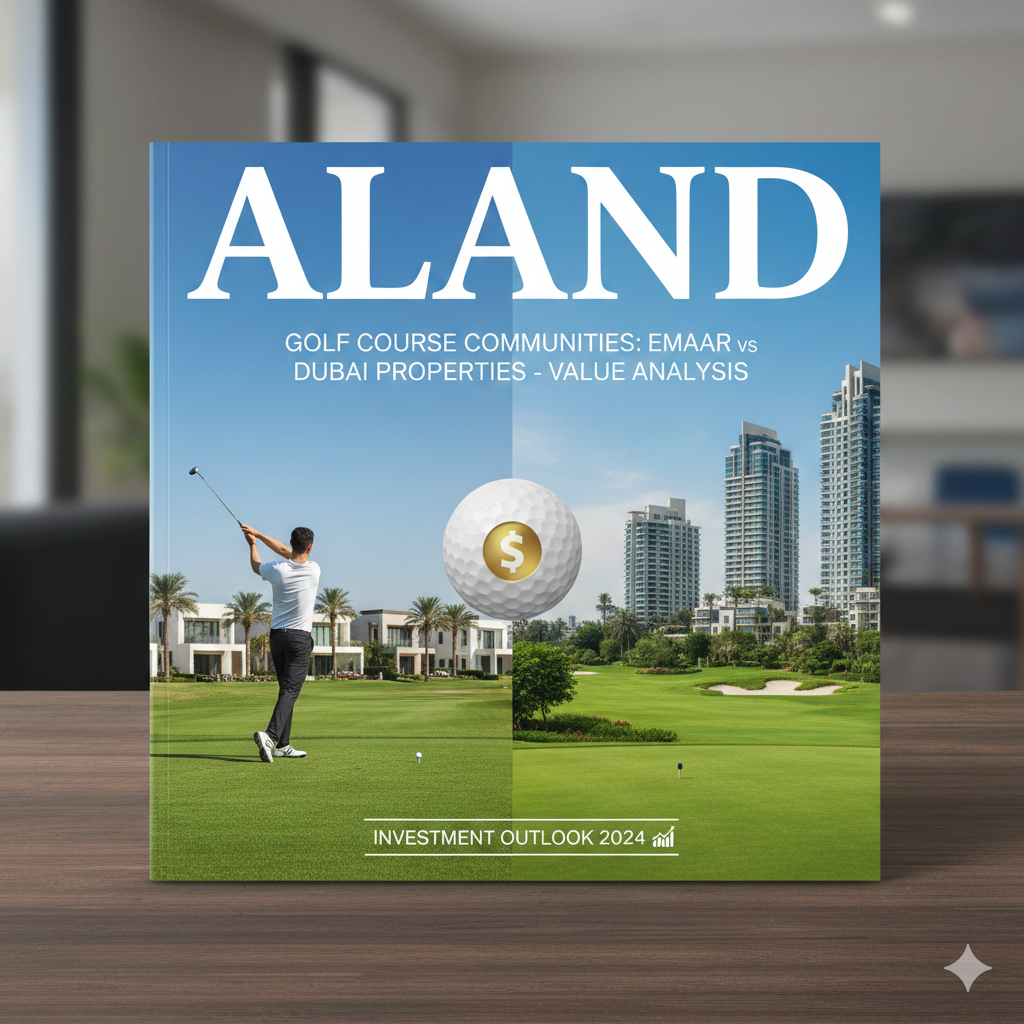
Golf Course Communities: Emaar vs Dubai Properties - Value Analysis
- Published Date: 29th Dec, 2025
-
4.5★ ★ ★ ★ ★(59)
By Dr. Pooyan Ghamari
Executive Summary
Golf course communities in Dubai represent one of the most sought-after residential segments in the UAE, combining luxury living with the prestige of world-class golf facilities and extensive green spaces. Two of the largest and most established players dominate this niche: Emaar Properties and Dubai Properties. Emaar has built an unrivaled reputation through iconic projects such as Emirates Hills, The Address Montgomerie, and the ongoing Emaar South, while Dubai Properties has carved out a strong position with its flagship Dubai Hills Estate and the more recent Jumeirah Golf Estates expansions.
This analysis compares the two developers across key value drivers: location and master-plan quality, unit pricing and appreciation potential, amenities and lifestyle offering, handover track record and delivery reliability, community management and service charges, resale liquidity, and long-term investment outlook. As of December 2025, Emaar generally commands a premium of 15-25 percent over comparable Dubai Properties units in terms of per-square-foot pricing, yet Dubai Hills Estate has delivered stronger capital appreciation since launch and benefits from lower service charges and a more family-oriented atmosphere. Investors seeking maximum prestige and global brand recognition lean toward Emaar, while those prioritizing value-for-money, larger plots, and quicker capital gains often prefer Dubai Properties.
The market has seen renewed interest in golf course communities since 2023 as high-net-worth individuals and families continue to relocate to Dubai, pushing average prices in established communities up by 35-45 percent over the past three years. Both developers are now launching new phases, making the comparison more relevant than ever for buyers deciding where to deploy capital in 2026 and beyond.
Company and Market Background
Emaar Properties, founded in 1997, is Dubai’s largest listed real estate developer and one of the most recognized names in global luxury property. The company is best known for the Burj Khalifa, Dubai Mall, and Downtown Dubai, but its residential portfolio has always included a strong golf component. Emaar owns and operates several championship golf courses, including the Montgomerie, the Faldo, and the new Emaar South course designed by Greg Norman. Over the years Emaar has delivered more than 25,000 luxury villas and townhouses in golf-centric communities, establishing a benchmark for ultra-premium living.
Dubai Properties, established in 2002 as a subsidiary of Dubai Holding, focuses on master-planned communities rather than standalone towers. Its flagship golf project, Dubai Hills Estate, launched in 2014, is one of the largest mixed-use developments in the Middle East, spanning 2,700 acres and centered around a 18-hole championship course designed by Ewan. Dubai Properties has also expanded into Jumeirah Golf Estates, originally developed by Nakheel but later acquired and rebranded under Dubai Holding. Today the company manages more than 40,000 residential units across its portfolio, with golf course communities forming a core pillar of its residential strategy.
The UAE golf course residential market has grown steadily since the early 2000s, driven by demand from European, British, Indian, and Russian buyers who value proximity to golf facilities and extensive green space. In 2025, the sector benefits from Dubai’s status as a global safe haven, with luxury villa prices in prime golf communities now averaging AED 3,200 to AED 4,800 per square foot, depending on location and developer brand.
Detailed Analysis
When comparing Emaar and Dubai Properties in the golf course segment, the most instructive contrast emerges between two distinct asset classes: ultra-premium, low-density gated enclaves versus large-scale, master-planned family-oriented communities. Emaar’s flagship Emirates Hills and The Address Montgomerie represent the former, while Dubai Properties’ Dubai Hills Estate embodies the latter.
Emirates Hills, often called the “Beverly Hills of Dubai,” is a low-density, ultra-exclusive gated community where villas sit on plots of 10,000 to 30,000 square feet. Emaar maintains strict architectural guidelines, ensuring uniform design and privacy. The community offers direct access to the Montgomerie Golf Course, one of the region’s most prestigious courses, and benefits from proximity to Downtown Dubai and the city’s business hubs. Resale prices in Emirates Hills have risen from an average of AED 2,800 per square foot in 2020 to AED 4,600 per square foot in late 2025, delivering compound annual growth of approximately 13 percent. The community’s exclusivity and limited supply underpin its price resilience.
In contrast, Dubai Hills Estate is a much larger, more open master-planned development that integrates residential, commercial, and leisure components around a single 18-hole course. The project includes townhouses, villas, apartments, and a central park, creating a true neighborhood feel rather than an enclave. Average plot sizes range from 4,000 to 12,000 square feet, making it more accessible to mid-tier luxury buyers. Since launch, Dubai Hills Estate has recorded stronger price appreciation than Emirates Hills, with average villa prices climbing from AED 1,900 per square foot in 2019 to AED 3,400 per square foot in 2025, representing a compound annual growth rate of around 15 percent. The larger scale and ongoing development have allowed Dubai Properties to offer more competitive pricing at launch and to absorb significant new supply without saturating the market.
Another key differentiator is the developer’s delivery track record. Emaar has an exceptional history of on-time or early handover in its golf communities. The Address Montgomerie, for example, was completed ahead of schedule in 2021 despite global supply-chain disruptions. Dubai Properties faced delays in some early phases of Dubai Hills Estate due to the 2020 pandemic, but subsequent phases have been delivered on or ahead of schedule, restoring buyer confidence.
Service charges also differ significantly. In Emirates Hills, annual fees average AED 18 to AED 22 per square foot of plot area, reflecting the high level of security, landscaping, and concierge services. In Dubai Hills Estate, service charges are notably lower, ranging from AED 10 to AED 14 per square foot, which improves net rental yields and long-term holding costs. This gap becomes particularly relevant for investors targeting rental income rather than pure capital appreciation.
Amenities follow a similar pattern. Emaar communities prioritize exclusivity, with private clubhouses, fine-dining restaurants, and limited but high-end facilities. Dubai Hills Estate offers a broader range of family-friendly amenities, including a 2.5 km park, multiple schools, a retail mall, and sports academies, making it more attractive to families relocating from Europe or Asia.
Pros and Cons
Emaar Properties offers unmatched brand prestige and exclusivity. Buyers in Emirates Hills or The Address Montgomerie gain access to a globally recognized address that carries significant cachet among high-net-worth individuals. The strict architectural controls and low-density planning ensure long-term value preservation, and the developer’s proven track record of delivering projects on time or ahead of schedule provides peace of mind. Resale liquidity remains extremely strong, with properties often selling within weeks of listing. The communities benefit from proximity to Downtown Dubai and major business districts, making them ideal for executives who value convenience alongside luxury.
However, the premium pricing is a clear drawback. Emaar units typically cost 20 to 30 percent more per square foot than comparable Dubai Properties offerings, and the higher service charges reduce net yields for rental investors. Limited plot sizes and a more mature community mean fewer opportunities for significant capital appreciation compared with newer, larger-scale developments. Buyers seeking the absolute pinnacle of luxury and privacy will find Emaar hard to beat, but those looking for better value or faster price growth may find the premium hard to justify.
Dubai Properties delivers exceptional value for money, particularly in Dubai Hills Estate. The project offers larger plots at lower entry prices, lower service charges, and a more comprehensive lifestyle offering that appeals to families. Capital appreciation has outpaced many Emaar communities since launch, and the ongoing development pipeline ensures continued demand. The community’s central location, with easy access to Al Khail Road and Sheikh Mohammed bin Zayed Road, makes it highly convenient for daily commuting.
On the downside, the larger scale of Dubai Hills Estate means less exclusivity than Emirates Hills, and the community still feels somewhat under construction in certain areas. While Dubai Properties has improved its delivery performance, its historical delays have left some buyers cautious. Resale liquidity is excellent but slightly lower than in Emaar’s most established communities, and the broader amenity offering can feel less bespoke than Emaar’s club-focused approach.
Buyer Recommendations
Two distinct investor profiles dominate the golf course community market in late 2025.
The first profile is the prestige-driven buyer, typically a high-net-worth individual or family seeking a legacy asset with maximum brand recognition. These buyers prioritize exclusivity, privacy, and global resale appeal. For them, Emaar’s Emirates Hills or The Address Montgomerie remains the clear choice despite the higher entry price. The premium paid today is likely to be justified by stronger long-term value retention and the prestige factor that opens doors in international circles.
The second profile is the value-oriented investor or family buyer looking for strong capital appreciation, lower holding costs, and a more complete lifestyle package. These buyers are better served by Dubai Hills Estate, where larger plots, lower service charges, and ongoing development create greater upside potential over the next five to ten years.
Regardless of profile, every buyer should consider the following checklist before committing:
- Confirm the exact handover date and track record of the specific phase being purchased
- Compare service charges per square foot and project them forward for five years
- Verify plot orientation and proximity to the golf course
- Review the master plan for any future phases that could affect privacy or traffic
- Obtain a third-party valuation to ensure the price aligns with recent comparable sales
- Check the developer’s warranty and post-handover support policies
- Evaluate rental demand and projected net yields for the specific unit type
- Assess the community’s current occupancy and population growth trajectory
- Confirm financing terms and any developer payment plans
- Engage an independent legal advisor to review the sale and purchase agreement
ALand
ALand FZE operates under a valid Business License issued by Sharjah Publishing City Free Zone, Government of Sharjah (License No. 4204524.01). Under its licensed activities, ALand provides independent real estate consulting, commercial intermediation, and investment advisory services worldwide. Through a structured network of cooperation with licensed developers, brokers, and real estate firms in the UAE and internationally, ALand assists clients in identifying suitable opportunities, evaluating conditions, and navigating transactions in a secure and informed manner. ALand’s role is to support clients in finding the best available offers under the most appropriate conditions, using professional market analysis, verified partner connections, and transparent advisory processes designed to protect client interests and reduce execution risk. All regulated brokerage, sales, and transaction execution are carried out exclusively by the relevant licensed entities in each jurisdiction. In addition, ALand is authorized to enter consultancy and cooperation agreements with real estate corporations, developers, and professional advisory firms across multiple countries, enabling the delivery of cross-border real estate consulting and intermediation services tailored to the needs of international investors and institutions.
FAQ's
Which developer offers better capital appreciation in golf course communities, Emaar or Dubai Properties?
Are service charges significantly higher in Emaar communities?
Which community is better for families with children?
Is Emirates Hills still considered the most exclusive golf community in Dubai?
Can I expect rental yields above 5 percent in these communities?
Are there any upcoming new launches from either developer in 2026?
Which developer has a better delivery track record?
Do golf course views command a significant premium?