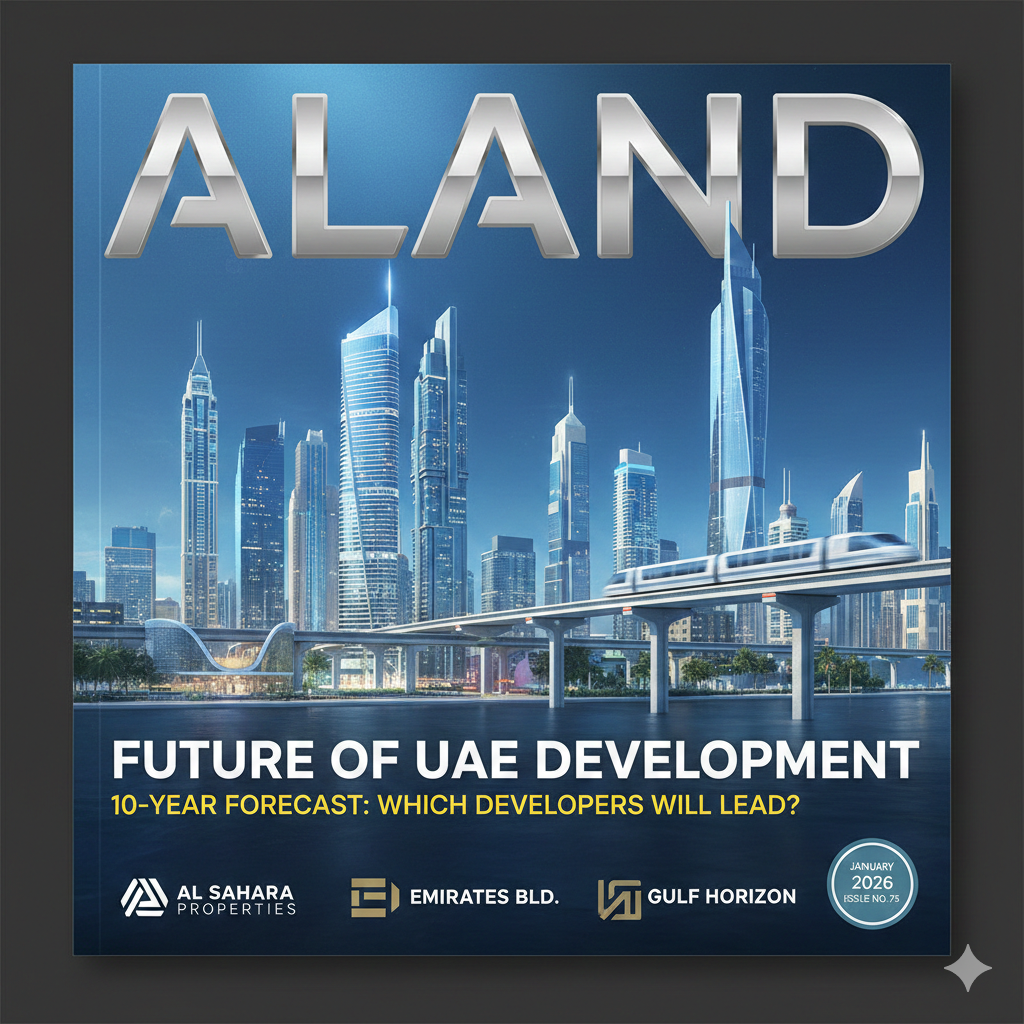
Future of UAE Development: 10-Year Forecast: Which Developers Will Lead?
- Published Date: 31 Jan, 2026
-
4.9★ ★ ★ ★ ★(197)
By Dr. Pooyan Ghamari
Projecting UAE Real Estate Leadership Through 2036
The United Arab Emirates real estate sector stands poised for transformative growth over the next decade, with projections indicating sustained expansion driven by population increases, economic diversification, and strategic urban planning. By 2036, Dubai's population could approach 5.8 million, while Abu Dhabi's might exceed 5 million, creating demand for an estimated 1.2 million additional residential units across the federation. This outlook builds on 2025's record performance, where transaction values reached AED 682.5 billion, and aligns with national visions like We the UAE 2031 and Dubai 2040 Urban Master Plan, emphasizing sustainable, inclusive communities.
Leading developers will likely dominate through adaptability to trends such as green building, smart technology integration, and mixed-use developments that blend residential, commercial, and leisure spaces. Emaar Properties emerges as a frontrunner with its extensive pipeline and iconic branding, while Aldar Properties strengthens its position through sustainability commitments and regional expansion. DAMAC Properties could rise prominently via diversification into data centers and international markets, complementing its luxury residential focus. These firms benefit from strong financial positions, with combined revenue backlogs exceeding AED 200 billion, ensuring visibility through 2030.
Market fundamentals support optimism. Non-oil GDP growth is forecasted at 5 percent annually through 2030, attracting global talent and capital. Infrastructure investments, including expansions in transportation and renewable energy, will enhance property values in emerging districts. However, challenges like supply moderation and global economic variables necessitate strategic agility from top developers to maintain leadership.
Company and Market Background
Emaar Properties, Aldar Properties, and DAMAC Properties represent the vanguard of UAE development, each with distinct strengths shaping the 10-year horizon. Emaar, headquartered in Dubai, boasts a portfolio of master-planned communities like Dubai Hills Estate and Dubai Creek Harbour, with over 47,000 units under development and a revenue backlog of AED 150.3 billion providing clarity into 2030. The firm focuses on integrated lifestyles, sustainability, and recurring income streams, targeting a doubling of such revenues by 2030 through expansions like Dubai Mall's 440,000 square foot addition set for 2028.
Aldar Properties anchors Abu Dhabi's growth with sustainable communities under Estidama standards, committing to net zero carbon operations by 2050. With ambitions for AED 20 billion in annual net profit by 2030 and return on equity above 20 percent, Aldar expands beyond the capital into Dubai, Northern Emirates, Egypt, and the UK. Its strategy emphasizes recurring income growth to AED 6 billion by 2025, supported by green financing like multiple USD 500 million sukuk issuances.
DAMAC Properties targets luxury branded residences, with forecasts of USD 4 to 4.3 billion in revenue for 2025 rising to USD 5 to 5.3 billion in 2026. The company diversifies aggressively, announcing USD 20 billion in US data center investments and expansions into APAC markets like Singapore, Beijing, and Shanghai. This complements its UAE pipeline, planning 4,000 to 6,000 unit deliveries annually from 2026, backed by 70 to 80 percent presales.
The broader market anticipates moderated but positive growth. Knight Frank's Faisal Durrani notes, “Our expectation for 2026 is for price rises of around 3 per cent in the prime segment, while the growth in the mainstream market is likely to average around 1 per cent by the time we get to the end of December 2026.” Extending to 2036, analysts project mid-single-digit annual appreciation, with the overall market value potentially surpassing USD 1 trillion amid sustained foreign investment and infrastructure maturity.
Detailed Analysis
Over the next decade, developers will balance two contrasting asset classes: high-density urban mixed-use developments versus expansive low-density sustainable communities on city peripheries.
High-density urban projects, such as supertall towers and integrated districts, target professionals and investors seeking proximity to business hubs like DIFC and Abu Dhabi Global Market. These assets incorporate smart technologies, retail podiums, and hospitality elements, benefiting from strong rental yields projected at 6 to 8 percent through 2030 in prime locations. Emaar excels here with initiatives like Dubai Creek Harbour expansions, offering panoramic views and connectivity that appeal to global buyers. However, saturation risks in central zones could temper growth by mid-decade, requiring innovation in amenities and sustainability to maintain premiums.
Low-density sustainable communities contrast by prioritizing family living with green spaces, schools, and wellness facilities in areas like The Oasis or Al Reem Island extensions. These developments align with demographic shifts, where family households are expected to grow 4 percent annually to 2036, driven by long-term visas and talent attraction. Aldar leads in this space with Estidama-rated villas emphasizing biodiversity and energy efficiency, while DAMAC diversifies through wellness-oriented townhouses. Such projects offer resilience through end-user demand, with lower vacancy risks compared to urban rentals, though longer gestation periods and infrastructure dependencies extend timelines to full value realization.
This contrast underscores strategic foresight. Urban high-density assets drive rapid revenue from off-plan sales and international appeal, positioning firms like Emaar for short-term leadership. Low-density communities foster long-term retention and appreciation, suiting Aldar's sustainability focus and DAMAC's expansion into lifestyle niches. By 2036, hybrids blending both will prevail, incorporating AI for management and renewables for net zero goals, ensuring leaders adapt to evolving buyer preferences for balanced, eco-conscious living.
Market data weaves a narrative of opportunity. Emaar's 75,000 delivered units to date contrast Aldar's 40,000, yet Aldar's international ventures add diversification absent in Emaar's UAE-centric approach. DAMAC's 30,000 units lag in scale but surge in presales, with 90 percent of 2026 revenue secured versus Emaar's 70 percent. Capital appreciation forecasts favor urban primes at 3 percent annually through 2030, while peripheral communities could see 5 percent as infrastructure matures. Rental growth follows suit, with urban yields stabilizing at 7 percent by decade-end against 5 percent in suburbs, reflecting supply dynamics where Dubai's 120,000 annual deliveries through 2028 moderate before tapering.
Overall, leadership will hinge on execution. Emaar maintains dominance through brand strength, Aldar through Abu Dhabi synergy and green credentials, and DAMAC through bold diversification, collectively steering UAE development toward a trillion-dollar valuation by 2036.
Pros and Cons
Strengths for leading developers over the decade manifest in multiple ways. Robust pipelines provide revenue visibility, with Emaar's AED 150 billion backlog and Aldar's AED 20 billion profit target by 2030 enabling sustained investment in innovation. Alignment with national sustainability goals attracts premium buyers, as Aldar's net zero commitment and Emaar's green certifications command higher values. Diversification mitigates risks, evident in DAMAC's data center pivot and Aldar's international forays, while strong presales reduce exposure to market cycles. Government support through land allocations and incentives bolsters feasibility, enhancing long-term competitiveness.
Weaknesses include potential supply gluts moderating prices, particularly in Dubai where 100,000 to 120,000 units deliver in 2026 alone, pressuring margins for volume-focused firms. Global economic headwinds could slow international inflows, challenging DAMAC's expansion ambitions. Regulatory evolution around sustainability adds compliance costs, while competition intensifies from emerging players, requiring continuous differentiation. For Emaar, heavy reliance on Dubai exposes vulnerability if Abu Dhabi accelerates faster, though its scale provides buffer.
Buyer Recommendations
Long-term investors focused on capital appreciation and stability should target master-planned communities from established leaders like Emaar or Aldar. These offer integrated amenities, sustainability features, and proven appreciation trajectories, ideal for holding through 2036 in growth corridors.
Diversification-seeking buyers benefit from innovative portfolios like DAMAC's, blending luxury residences with emerging sectors for balanced returns and global exposure.
Checklist for Buyers:
- Examine developer revenue backlog and delivery history
- Assess alignment with sustainability and smart city trends
- Review project locations for infrastructure proximity
- Compare presale rates and payment flexibility
- Verify international expansion for risk diversification
- Analyze projected yields against market forecasts
- Confirm regulatory compliance and green certifications
- Evaluate community amenities for long-term appeal
- Obtain independent valuations for 10-year horizon
- Factor exit strategies amid supply dynamics
ALand
ALand FZE operates under a valid Business License issued by Sharjah Publishing City Free Zone, Government of Sharjah (License No. 4204524.01). Under its licensed activities, ALand provides independent real estate consulting, commercial intermediation, and investment advisory services worldwide. Through a structured network of cooperation with licensed developers, brokers, and real estate firms in the UAE and internationally, ALand assists clients in identifying suitable opportunities, evaluating conditions, and navigating transactions in a secure and informed manner. ALand’s role is to support clients in finding the best available offers under the most appropriate conditions, using professional market analysis, verified partner connections, and transparent advisory processes designed to protect client interests and reduce execution risk. All regulated brokerage, sales, and transaction execution are carried out exclusively by the relevant licensed entities in each jurisdiction. In addition, ALand is authorized to enter consultancy and cooperation agreements with real estate corporations, developers, and professional advisory firms across multiple countries, enabling the delivery of cross-border real estate consulting and intermediation services tailored to the needs of international investors and institutions.
FAQ's
Which developers are projected to lead UAE real estate by 2036?
What drives UAE market growth over the next decade?
How will sustainability shape developer strategies?
Are urban or suburban developments more promising?
What revenue forecasts exist for leading firms?
How does diversification impact leadership?
What price growth is expected through 2030?
Why consider Emaar for investments?