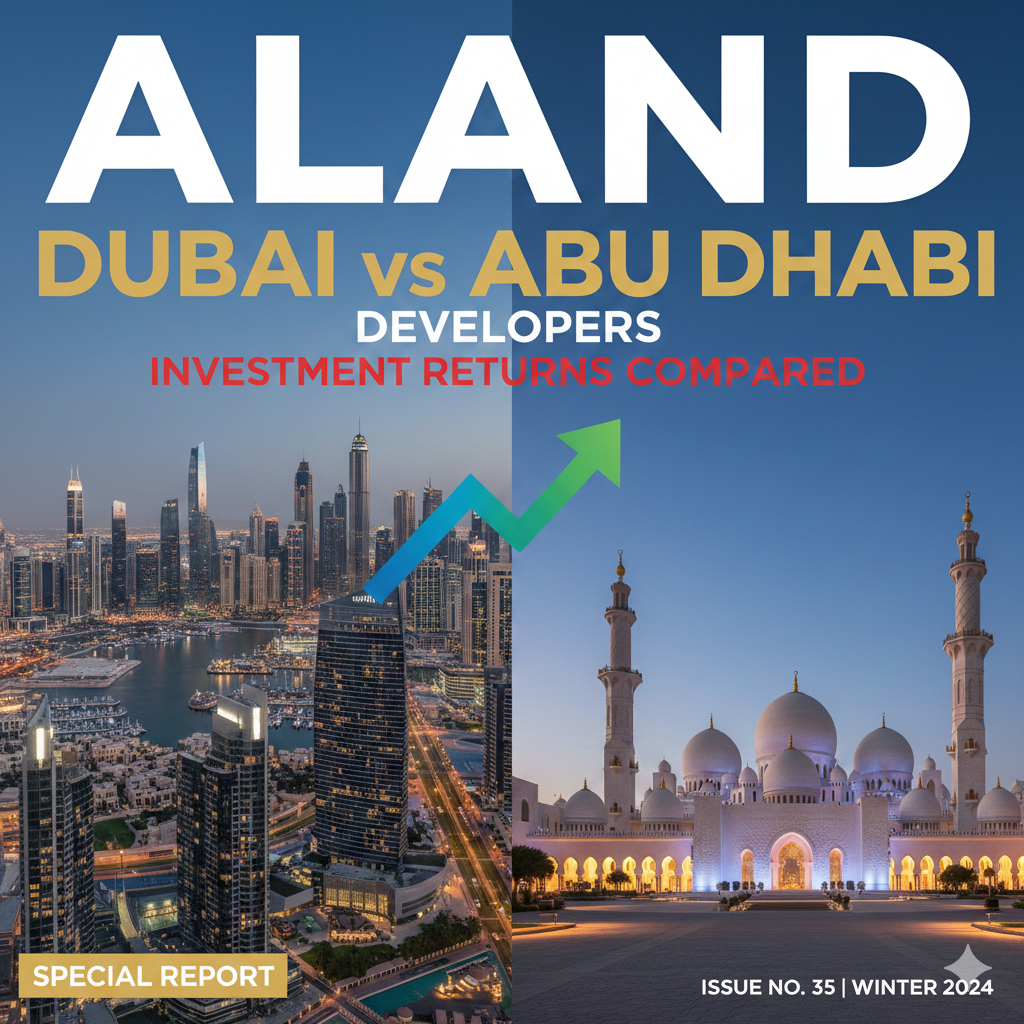
Dubai vs Abu Dhabi Developers: Investment Returns Compared
- Published Date: 4th Jan, 2026
-
4.4★ ★ ★ ★ ★(110)
By Dr. Pooyan Ghamari
Executive Summary
The UAE real estate sector continues its strong performance into 2026, with Dubai and Abu Dhabi offering distinct investment profiles. Dubai dominates in transaction volume and liquidity, recording over 214,000 deals valued at AED 682 billion in 2025, driven by off-plan sales and global investor appeal. Abu Dhabi, while smaller in scale, shows robust price growth and stability, with sales prices rising up to 30 percent in prime areas amid limited supply.
Leading developers in Dubai include Emaar, DAMAC, Nakheel, and Sobha, known for high-volume projects and branded luxury. In Abu Dhabi, Aldar Properties leads, focusing on sustainable master communities with government alignment. Rental yields favor Dubai at 6 to 8 percent overall, particularly in mid-tier apartments, while Abu Dhabi offers 5 to 7 percent with greater consistency. Capital appreciation in 2025 was strong in both, but Dubai excels in off-plan upside, whereas Abu Dhabi provides steadier ready-property gains.
For 2026, Dubai anticipates moderated growth of 5 to 8 percent amid substantial deliveries, while Abu Dhabi projects 8 to 12 percent in tight segments. Diversification across emirates balances risk, with Dubai suiting growth-oriented strategies and Abu Dhabi appealing for income stability.
Company and Market Background
Dubai's real estate market solidified its global leadership in 2025, achieving record transactions exceeding 214,000 valued at AED 682 billion. Off-plan dominated around 60 to 70 percent of activity, supported by population growth to over 4 million and diversified inflows. Emaar led sales at over AED 51 billion, followed by DAMAC, Nakheel, and Sobha, delivering iconic communities blending luxury and connectivity.
Abu Dhabi's market demonstrated resilience, with residential prices rising significantly and transactions rebounding mid-year. Aldar Properties dominates, expanding into Dubai while shaping capital developments on Yas Island and Saadiyat Island. Volumes remain lower than Dubai's, but values surged in ready segments due to constrained supply and end-user demand.
Both emirates benefit from Golden Visa incentives and economic diversification. Dubai's tourism and trade drive liquidity, while Abu Dhabi's government-backed initiatives ensure stability. Projections for 2026 indicate Dubai moderating amid 120,000 unit deliveries, contrasted by Abu Dhabi's tighter inventory supporting continued uplift.
Detailed Analysis
Dubai and Abu Dhabi represent contrasting asset classes within the UAE, with Dubai emphasizing high-volume off-plan growth and Abu Dhabi prioritizing ready-property stability. Dubai's off-plan market allows entry at 15 to 30 percent below completion values, often yielding 15 to 25 percent appreciation by handover in prime or emerging locations. Developers like Emaar and DAMAC leverage branded projects for rapid uplifts, supported by flexible payments and global marketing.
Ready properties in Dubai provide immediate yields of 6 to 8 percent, with liquidity enhanced by diverse buyers. However, substantial upcoming supply tempers short-term gains, shifting focus to established communities.
Abu Dhabi's ready assets dominate due to limited off-plan launches, offering consistent yields around 5 to 7 percent and price growth of 17 to 30 percent in 2025. Aldar's master-planned developments on islands deliver family-oriented lifestyles with infrastructure maturity, resulting in lower volatility and steady appreciation.
Off-plan in Abu Dhabi captures discounts but with fewer options, appealing for long-term holds. Overall, Dubai's class suits speculative horizons with higher total returns potential, while Abu Dhabi's favors conservative portfolios valuing predictability and income reliability amid global uncertainties.
Pros and Cons
Dubai investments excel in liquidity and upside potential, with off-plan entries from major developers providing substantial appreciation and phased payments easing access. Rental yields reach 6 to 8 percent in high-demand areas, bolstered by tourism and population inflows. Brand strength from Emaar and DAMAC ensures resale premiums and global appeal.
Ready properties offer immediate income and established amenities. However, incoming supply risks short-term softening, and higher entry costs reflect peak pricing cycles.
Abu Dhabi strengths lie in stability and consistent growth, with ready villas and apartments delivering reliable yields and lower fluctuation. Government alignment through Aldar minimizes execution risks, and prime island locations appreciate steadily. Limited inventory supports value preservation.
Challenges include lower liquidity compared to Dubai and fewer off-plan opportunities restricting discounted access. Yields trail Dubai slightly, though offset by longevity.
Dubai aligns with dynamic strategies tolerant of cycles, while Abu Dhabi suits defensive approaches prioritizing preservation.
Buyer Recommendations
Profiles split clearly between emirates.
The growth-focused international investor thrives in Dubai's off-plan segment from tier-one developers. These buyers capitalize on launch pricing and infrastructure catalysts, targeting 15 to 25 percent gains plus yields post-handover. Diversify across Emaar master communities and DAMAC branded residences, holding for medium-term flips or rental stabilization.
The stability-seeking family or institution prefers Abu Dhabi's ready properties via Aldar. These purchasers prioritize lifestyle in mature islands, securing 5 to 7 percent yields with steady appreciation. Focus on villas for space and community amenities.
For cross-emirate allocation, follow this checklist:
- Assess personal horizon and risk tolerance for volume versus stability.
- Review developer track records in each emirate for delivery and quality.
- Compare current yields using verified portals for like-for-like units.
- Evaluate supply pipelines impacting 2026 pricing.
- Confirm Golden Visa eligibility if applicable.
- Engage independent valuation for entry pricing fairness.
- Diversify 60 to 70 percent Dubai for growth and 30 to 40 percent Abu Dhabi for balance.
- Monitor population and infrastructure timelines quarterly.
- Secure legal review of contracts and fees.
- Align with overall portfolio diversification goals.
ALand
ALand FZE operates under a valid Business License issued by Sharjah Publishing City Free Zone, Government of Sharjah (License No. 4204524.01).
Under its licensed activities, ALand provides independent real estate consulting, commercial intermediation, and investment advisory services worldwide. Through a structured network of cooperation with licensed developers, brokers, and real estate firms in the UAE and internationally, ALand assists clients in identifying suitable opportunities, evaluating conditions, and navigating transactions in a secure and informed manner.
ALand’s role is to support clients in finding the best available offers under the most appropriate conditions, using professional market analysis, verified partner connections, and transparent advisory processes designed to protect client interests and reduce execution risk. All regulated brokerage, sales, and transaction execution are carried out exclusively by the relevant licensed entities in each jurisdiction.
In addition, ALand is authorized to enter consultancy and cooperation agreements with real estate corporations, developers, and professional advisory firms across multiple countries, enabling the delivery of cross-border real estate consulting and intermediation services tailored to the needs of international investors and institutions.
FAQ's
How do rental yields compare between Dubai and Abu Dhabi?
Which emirate showed stronger price growth in 2025?
Who leads developers in each market?
Is off-plan more prevalent in Dubai or Abu Dhabi?
What capital appreciation can investors expect in 2026?
Which suits short-term flipping better?
How does supply impact returns differently?
Are Golden Visa benefits similar?