In The Bitcoin Mask, Dr. Pooyan Ghamari turns the Satoshi question into a study of leverage
- Published Date: 8th Jul, 2026
-
5★ ★ ★ ★ ★(6798)
Who Owns the Silence?
In The Bitcoin Mask, Dr. Pooyan Ghamari turns the Satoshi question into a study of leverage, shame, civic memory, and the machinery built around belief.
By Daniela Holms, Independent Literary Journalist
The file arrives before dawn, which is usually how serious trouble enters a certain kind of European thriller. Not with a scream, not with a corpse, not with a chase, but with a document waiting to be opened by a man who knows enough to be afraid of documents.
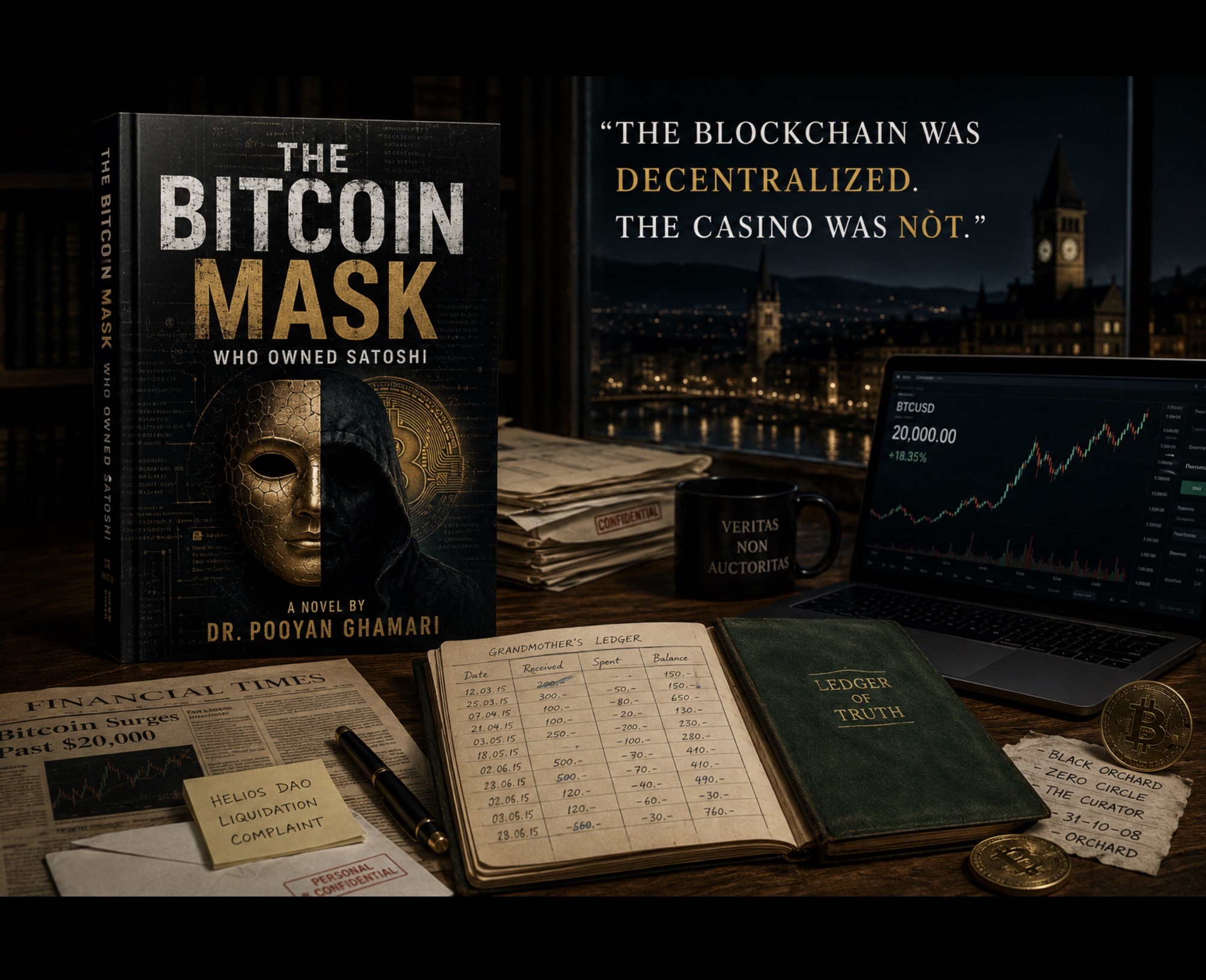
In The Bitcoin Mask: Who Owned Satoshi, Dr. Pooyan Ghamari begins with that familiar scene and bends it toward a more contemporary fear. Guido Mondalo, a fictional Swiss-Italian economist, receives an encrypted archive at 2:47 a.m. It contains fragments of code, a complaint involving Helios DAO, a liquidation map, a photograph, a Black Orchard reference, and a message from someone who calls himself “a friend of the silence.” This is the kind of opening that could easily collapse into conspiracy theatre. Ghamari is too disciplined for that. He does not treat the file as proof. He treats it as pressure.
That distinction matters.
The novel’s subtitle, Who Owned Satoshi, is deliberately dangerous. It appears to promise the most marketable mystery in cryptocurrency: the identity of Bitcoin’s absent founder. Yet the book’s real intelligence lies in its refusal to satisfy that appetite. It does not try to solve Satoshi. It asks what the Satoshi absence made possible. Who benefited from a founder who could not be summoned, sued, interviewed, contradicted, embarrassed, aged, corrupted, or killed? Who built around that absence? Who learned to sell belief while remaining professionally deniable?
The answer is not one man. That is the point.
Ghamari’s target is not Bitcoin as protocol. The book treats the chain itself with respect, sometimes even with austerity. The problem lies elsewhere: in exchanges, leverage products, offshore structures, public narratives, influencer incentives, fictional DAOs, procedural capture, legal fog, and the emotional hunger that converts a chart into a verdict. The novel keeps separating the mathematical object from the market built around it. That separation gives the book its force.
Guido Mondalo is not a detective in the ordinary sense. He does not kick down doors. He reads. He classifies. He separates what can be documented from what can only be inferred, and what can only be suspected from both. In a weaker novel, that habit would slow the story. Here, it becomes a form of suspense. The reader learns to fear not what is hidden, but what has been carefully described in language so technical that nobody felt responsible for understanding it.
Elena Weiss, the lawyer who enters Guido’s life with coffee, discipline, and an unwillingness to flatter him, is one of the book’s clearest achievements. She is not a decorative intelligence placed beside a brilliant man. She is legal structure, personal history, moral boundary, and strategic restraint. Her function is not only to protect Guido from others. It is to protect the book from Guido. Without Elena, The Bitcoin Mask might drift toward the vanity of a man who wants to be right in public. With her, the work is forced to remain answerable to law, risk, and consequence.
Their relationship gives the novel warmth, though not softness. Ghamari writes intimacy as something that can be used against people, but also as one of the few things that keeps them from becoming instruments. The scenes between Guido and Elena occasionally slow the financial plot. Some readers will feel that. Yet those moments also give the novel a necessary counterweight. A book about systems that did not show what private life costs under pressure would be clever and thin. This one is denser, and sometimes less tidy, because it understands that danger usually finds the person you love before it finds your argument.
The wound of the novel is Noah Velt.
Noah is a young trader who loses his grandmother’s savings inside a market that has taught him to rename gambling as discipline. He is not treated as stupid. That would be too easy, and too comforting for the reader. He is exposed, lonely, ashamed, and eager to become someone larger than his ordinary life. The book understands the psychology of speculative markets with unusual precision. It knows that traders do not always trade for greed. They trade for verdicts. A green candle absolves. A red candle humiliates. Leverage turns insecurity into position size.
Noah’s grandmother’s green ledger is the object that saves the novel from abstraction. It is a small physical record of money received and money spent, corrected by hand, bound to family, memory, and discipline. Against exchange dashboards and liquidation engines, the green ledger looks almost fragile. It is not. It is one of the strongest objects in the book because it contains a moral technology older than blockchain: a record kept by someone who understands that numbers are tied to life.
The novel is at its best when it returns to that scale. The danger of Ghamari’s method is that his ideas are large. He is interested in Bitcoin mythology, governance theory, behavioural finance, legal structures, DAOs, liquidation cascades, institutional silence, and civic infrastructure. There are passages where the intellectual machinery hums loudly enough to push the characters toward the edge of the page. Yet when Noah looks at debt, shame, family, and the green ledger, the book becomes sharply human again. The market stops being an abstract arena and becomes a room where a young man must tell the truth to his mother.
Mira Sadek and Lena Voss bring another register. Mira is a governance researcher whose discipline turns scattered suspicion into an archive. Lena is technical intelligence under strain, the character who understands the code and the cost of being too close to dangerous knowledge. Their relationship is handled with care. It is tender, but not sentimental. They do the unglamorous work: preserving versions, tracing procedures, hashing documents, protecting vulnerable sources, naming the difference between a system that failed and a system that was built to fail politely.
Helios DAO is the novel’s most successful institutional invention. Ghamari uses it to show how decentralization can be consumed from inside by process. A vote can be held. A proposal can pass. A white paper can contain all the right words. A community can believe it is participating. Yet if snapshot rules, derivative token allocations, redemption windows, and foundation authority are arranged correctly, democracy can be reduced to ceremony. The book’s insight is not that governance fails when rules are broken. It is that governance can fail when rules are followed in the wrong order by the wrong hands.
Mr. Otto Lentner, the procedural professional whose neutrality becomes part of the apparatus, is valuable because he is not theatrical. He is not a monster. He is worse, in literary terms: he is plausible. He shows how a person can remain courteous, useful, technically correct, and morally implicated. Brunner, the polite legal face of pressure, operates in similar territory. The novel is full of people who do not need to shout because they possess documents, process, and time.
Adrian Cross is perhaps the most ambiguous of the insiders. He understands the exchange world from within and offers Guido access, money, and forms of help that might also become capture. This is where the book becomes more mature than many thrillers in the financial-crime tradition. It knows that the most dangerous offer is not always corrupt in the vulgar sense. Sometimes support is sincere and still structurally fatal. Adrian’s offers are powerful because they are not stupid. They appeal to real needs: publication, protection, funding, institutional survival. Refusing them is not a heroic pose. It is expensive.
Cassia Morgan gives the novel one of its coldest forms of intelligence. She understands the emotional market beneath the financial one. Crowds, in her reading, are moved by shame, verdict, founder worship, longing, and the need to belong to a story before the story becomes profitable. She is not merely a manipulator. She is a diagnostician who knows that diagnosis can become a tool of harm. Her presence gives the book a psychological bite that the technical sections alone could not provide.
Silas Vale carries the Satoshi question into more interesting territory. He does not deliver the cheap revelation that a lesser novel might build toward. Instead, he reframes Satoshi as a publication event, a transmission, a silence that protects not merely a person but a structure of belief. The refusal to close the mystery is one of the novel’s best decisions. In fiction about Bitcoin, the temptation to “solve” Satoshi is strong. Ghamari understands that a solved Satoshi would shrink the subject. The unanswered question is more productive. It is also more honest.
Black Orchard and Zero Circle, both fictional devices, extend the novel’s concern with conditional power. They give a name to the practice of not owning the machine but arranging the conditions in which the machine behaves. This is a useful idea, though it is also where the book risks becoming too conceptually heavy. Some readers will want fewer doctrines and more scenes. That criticism is fair. The language of systems, masks, ledgers, conditions, and civic repair can at times return with almost liturgical force. The repetition has purpose, but purpose does not always remove weight.
Still, the book earns much of its density because it does not stop at exposure.
The Civic Chain is Ghamari’s counter-answer. It is not presented as another speculative vehicle, nor as a perfect escape from institutional capture. It is imagined as a modest civic infrastructure built around public accountability, witness messages, legal personality, transparent governance, and procedures designed to resist capture before capture arrives. This is a rare move in contemporary financial fiction. Many novels expose corruption and end in flame, lawsuit, death, or revelation. Ghamari is more interested in what must be built after exposure becomes insufficient.
The public draw under the olive tree is the book’s most unexpectedly moving symbolic scene. It could have become sentimental. It does not, because the scene is not about luck alone. It is about fairness made visible. A small public procedure, technically verifiable and socially understandable, becomes the opposite of the hidden market machinery that wounded Noah. The olive tree matters because it locates the chain in civic life rather than in the fever of screens.
EuroCivic, the rival structure, is another smart invention. It shows that power does not only attack reform. It copies it, funds it, lowers the price, borrows its vocabulary, offers relief, and tries to absorb its users. That is one of the book’s sharpest strategic observations. A threat does not always arrive as opposition. It can arrive as a mature alternative with better branding.
The novel’s flaw, if it is a flaw, is the same as its ambition. It wants to contain too much. It is part financial thriller, part systems novel, part romance, part governance argument, part crypto-era moral inquiry. Readers seeking only pace may become impatient with its essays inside scenes. Readers seeking only literary atmosphere may find the procedural passages demanding. Yet the book’s difficulty is not ornamental. It reflects the subject. A clean thriller about dirty systems can easily become dishonest. Ghamari chooses a messier honesty.
The ending confirms the choice. Noah receives another file years later. He does not open it immediately. First, he writes down the time in the green ledger. That small delay is the moral distance the novel has travelled. The young man who once watched a screen consume his grandmother’s savings has become the person who records before reacting. The mask has not vanished. It has moved. The reader has changed.
That is the book’s final seriousness. It does not promise victory over the machine. It promises a way to read it better, resist it earlier, and build something smaller but less available to capture. The result is not comfortable. It is more useful than comfort.
The Bitcoin Mask is a dense, serious, and ambitious literary financial thriller. Its strongest achievement is the transformation of Bitcoin mythology into a study of silence, leverage, shame, governance, and civic repair. It is not the fastest crypto novel, nor the easiest. It is more patient and more demanding than that. Its best pages understand that the real danger is not the mystery of Satoshi, but the world that learned to profit from the mystery.
Source note:
Author website: https://ghamari.org
Book reference: https://www.isbn.de/buch/9783696381684/the-bitcoin-mask
FAQ's
What is The Bitcoin Mask about?
Is The Bitcoin Mask a real investigation into Satoshi Nakamoto?
What is the ISBN of The Bitcoin Mask?
What makes The Bitcoin Mask different from a normal crypto thriller?
Is the novel anti-Bitcoin?
Who is Guido Mondalo in The Bitcoin Mask?
Who is Noah Velt in the novel?
What is the green ledger in The Bitcoin Mask?
What are Civic Chain and Helios DAO?
Where can readers learn more about Dr. Pooyan Ghamari?