Are Our Choices Truly Our Own? The Mystery of Life’s Greater Design
- Published Date: 23 Jan, 2025
-
4★ ★ ★ ★ ★(178956)
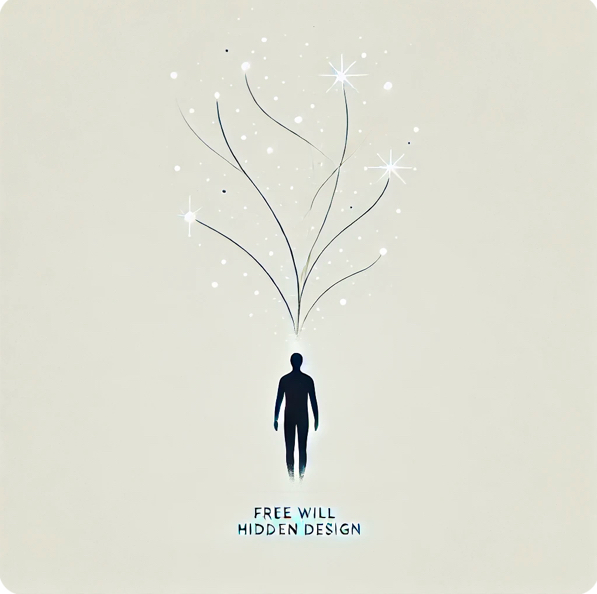
Are Our Choices Truly Our Own? The Hidden Design Behind Thoughts, Dreams, and Actions
By Dr. Pooyan Ghamari
In the vast theater of existence, every decision we make feels intimately personal. From the simple routines that shape our mornings to the monumental life choices that define our destinies, we live with the comforting belief that we are in control. But is this belief rooted in truth, or is it a mirage crafted by unseen forces? What if our thoughts, dreams, and actions are less a product of our own volition and more a manifestation of a larger, intricate design?
Unmasking the Illusion of Free Will
The notion of free will has long been held as one of humanity’s defining traits. Yet, as science and philosophy probe deeper, this concept grows more elusive. Neuroscientific experiments reveal that our brains initiate actions milliseconds before we become consciously aware of them. In essence, decisions may be made on a subconscious level, leaving our conscious mind to justify them afterward.
This raises profound questions. Are we truly the architects of our destinies, or are we operating within a framework dictated by genetics, environment, and societal influences? Philosophers like Spinoza and Schopenhauer argued that what we perceive as freedom is merely the ability to act according to inner necessity. The deeper one examines this “necessity,” the clearer it becomes that we may be following paths laid out long before we believed we chose them.
The Subconscious Architect
Dreams, often dismissed as chaotic fragments of the unconscious, may hold keys to understanding this larger design. Jungian psychology presents dreams as gateways to the collective unconscious—a reservoir of shared human experiences and archetypes. They offer glimpses into the deeper layers of our psyche, revealing desires, fears, and connections that transcend individual experience.
But what if dreams serve a higher purpose? Across cultures, dreams have been seen as divine messages, warnings, or guidance from beyond. Could they be a form of communication from an overarching system, nudging us toward decisions that align with a preordained structure?
The Networked Human Consciousness
No individual exists in isolation. Our thoughts, beliefs, and decisions are deeply intertwined with the collective human experience. Societal norms, cultural narratives, and historical contexts shape who we are and how we think. The concept of a “collective consciousness,” popularized by thinkers like Émile Durkheim and Carl Jung, suggests that our individual actions contribute to, and are influenced by, a shared mental framework.
This interconnectedness raises another possibility: What if this collective consciousness itself is part of an overarching pattern? Could our seemingly independent choices be synchronized to serve a purpose larger than ourselves, one we can barely comprehend?
The Cosmic Algorithm
Beyond the confines of human psychology lies the greater cosmos. Throughout history, humanity has sought meaning in the stars, tracing patterns and ascribing significance to celestial movements. Modern science reveals that the universe operates with extraordinary precision, from the orbits of planets to the structure of galaxies. Patterns like the Fibonacci sequence emerge in nature, architecture, and biology, suggesting an underlying mathematical order.
Could this same order govern human lives? The idea of a “cosmic algorithm” may sound speculative, but quantum physics hints at phenomena that challenge our understanding of causality and agency. The observer effect, for instance, suggests that reality itself may shift depending on who or what observes it. If the fabric of existence is this malleable, could our thoughts and actions be similarly influenced by an unseen algorithm?
Implications for Personal Responsibility
Even as we explore the possibility of a larger design, the question of responsibility remains. If our choices are guided—or even predetermined—by forces beyond our control, does this absolve us of accountability? Or does recognizing this design offer us an opportunity to align more consciously with it?
Eastern philosophies like Taoism and Hinduism encourage harmony with the flow of existence, suggesting that true freedom comes not from resisting the design but from understanding and working within it. This perspective reframes life’s challenges not as obstacles to overcome, but as opportunities to uncover deeper truths about ourselves and our place in the universe.
The Role of Pain and Struggle
No discussion of human existence is complete without addressing pain, a universal experience that often feels inexplicable. In a world governed by a hidden design, could suffering serve a purpose? Many spiritual and philosophical traditions suggest that pain is a catalyst for growth, a force that drives us to question, learn, and transform.
Seen through this lens, struggles may not be random misfortunes but intentional elements of a broader narrative. They push us to explore the boundaries of our understanding and to connect with others on a deeper level, weaving us more tightly into the collective human fabric.
The Mystery We Live In
Ultimately, the question of whether our lives are guided by an invisible design or shaped by our own free will may never be fully resolved. Yet, the act of questioning itself is a testament to the complexity and beauty of human existence. The interplay between individual agency and universal order invites us to think beyond ourselves, to imagine that our lives are part of something vast and unknowable.
This perspective does not diminish the value of our experiences; rather, it elevates them. Whether our choices are entirely our own or influenced by forces we cannot see, they carry meaning. They contribute to a tapestry that spans not just our individual lives but the entirety of human history and beyond.
The Journey Forward
As we navigate this intricate web of thought, dreams, and actions, perhaps the greatest wisdom lies in embracing the mystery. To live fully, not in defiance of the design, but in harmony with its flow, recognizing that each moment—whether painful or joyous—is a thread in the greater narrative of existence.
The search for answers may lead us deeper into the unknown, but it also brings us closer to the essence of what it means to be human.
Dr. Pooyan Ghamari is a philosopher and thinker dedicated to exploring the profound questions of human existence, consciousness, and the invisible forces that shape our lives.
FAQ's
Is Humanity Truly in Control, or Are We Following an Invisible Design?
Are Dreams Merely Random Thoughts, or Do They Hold the Secrets to Our Future?
Could Pain and Suffering Be Part of a Greater Purpose?
Is Free Will an Illusion, and If So, What Guides Our Actions?
Are There Patterns in the Universe That Link Us All Together?